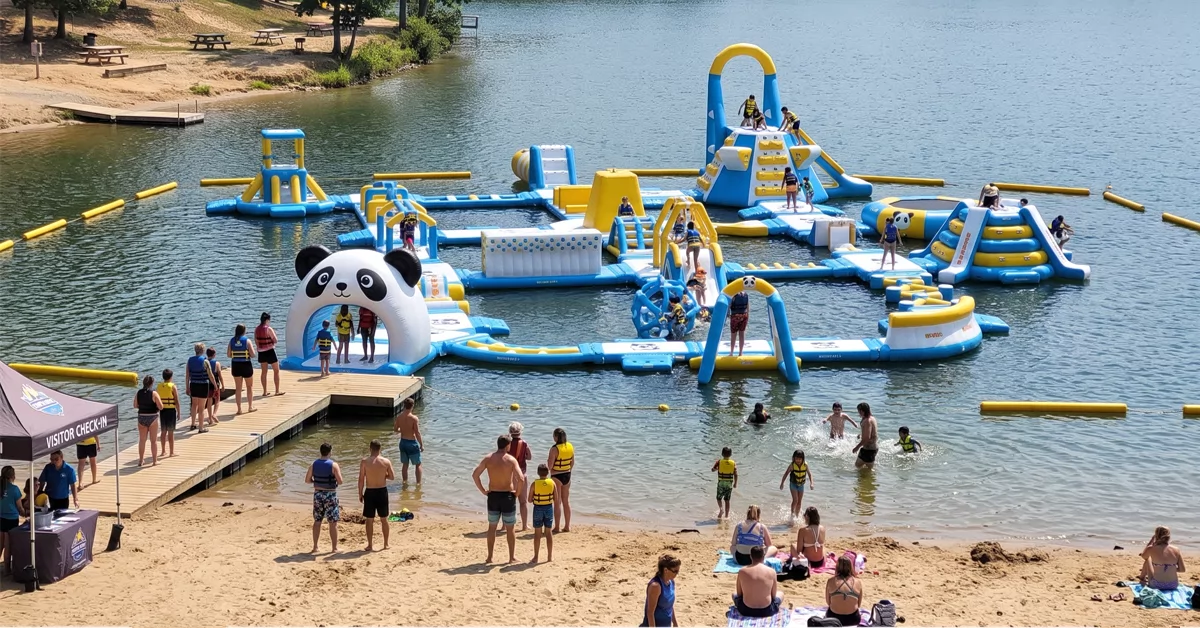
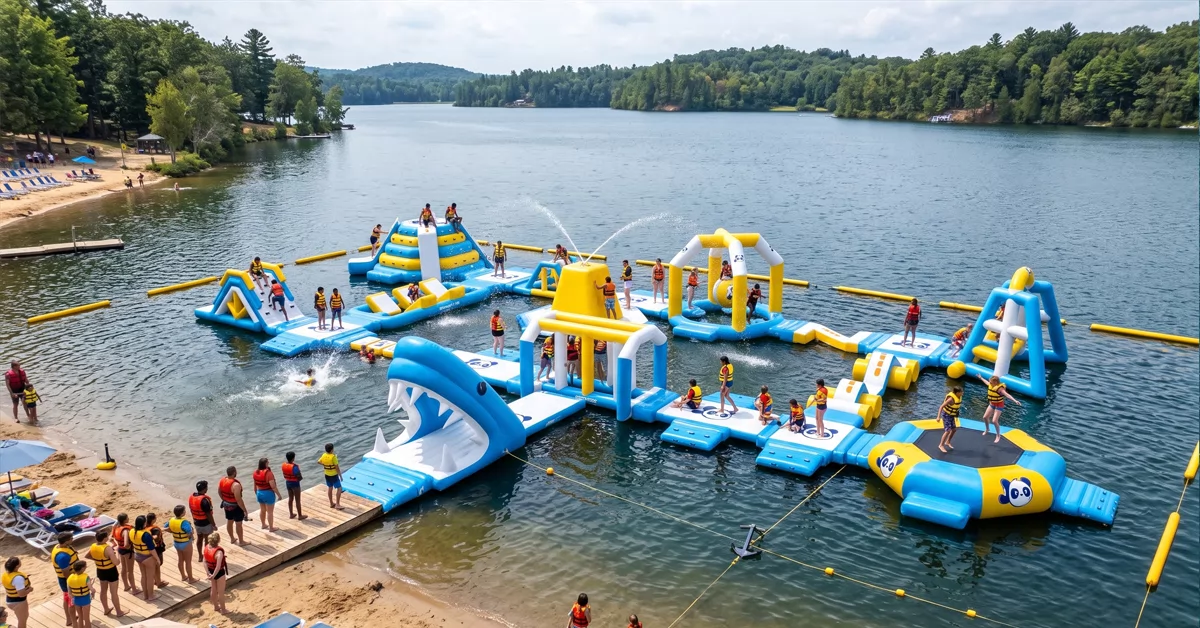
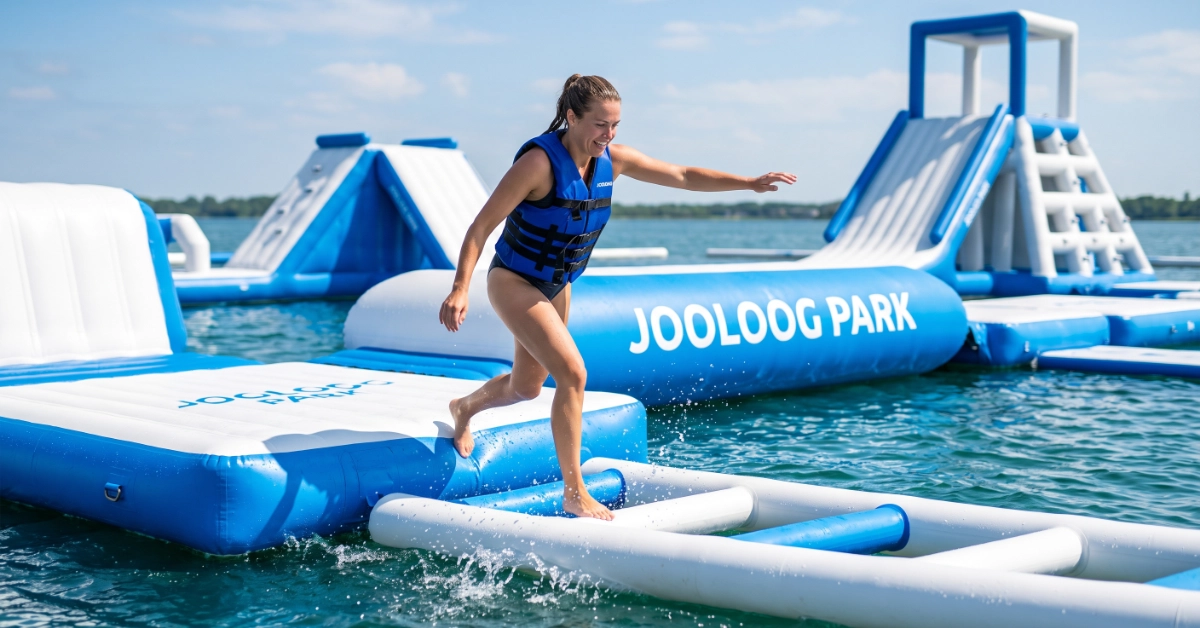
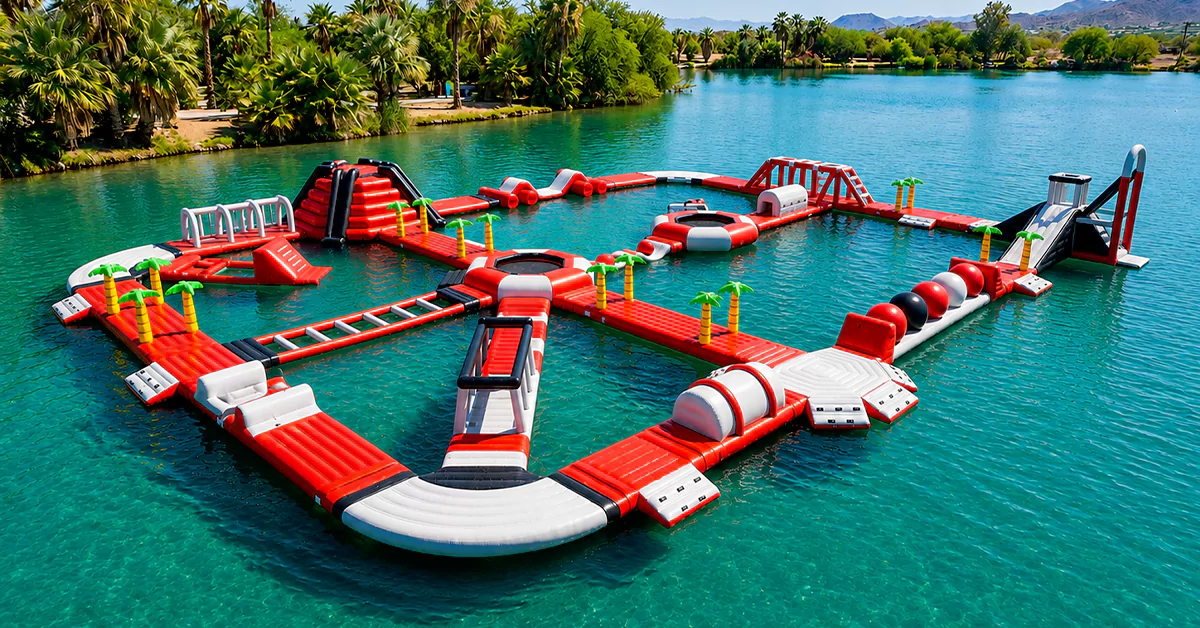
In short: most inflatable water parks don't fail on visitor numbers — they fail on spend per guest. The ticket gets you a full park; the margin comes from what guests buy once they're wet, how well you fill the calendar, and what an open day costs you. Five levers do most of that work, and none of them needs better weather.
If you haven't bought yet, start with what an inflatable water park actually costs and the ROI benchmarks for campgrounds and resorts. This piece picks up the morning after opening day.
The Profit Equation, Written Out
Profit is not a feeling about how busy Saturday looked. It reduces to three numbers:
Profit = (visits × spend per guest) − cost per open day
Visits are capped by capacity and season length, and both are fixed once you've bought. Spend per guest, pricing, and cost per day are not — and they move first.
Here's what a healthy mix looks like for a 100-day inflatable water park selling roughly 18,000 visits a season. The percentages are planning ranges, not rules; the point is the shape, not the digits.
| Line | Share of gross revenue | What it depends on |
|---|---|---|
| Admission | 55–65% | Ticket price × visits |
| Food and beverage | 12–18% | Dwell time, menu speed, shade |
| Premium zones (cabanas, islands, decks) | 8–14% | Seat tiers, session pricing, sightlines |
| Groups and events | 5–10% | Midweek fill, minimum spends |
| Retail, photos, rentals | 3–8% | Attach rate at the gate |
And on the other side, what an open day costs:
| Cost line | Share of gross revenue |
|---|---|
| Labor (lifeguards, gate, F&B, supervisors) | 22–30% |
| Cost of goods (F&B, retail) | 6–8% |
| Energy and blowers | 3–5% |
| Maintenance and repairs | 3–5% |
| Insurance | 4–7% |
| Marketing | 5–8% |
| Booking and payment fees | 2–3% |
| Mooring, permits, land or lease | 2–6% |
A park that lands in these bands keeps roughly 40–45 cents of every revenue dollar before finance costs and tax. A park that misses on two or three lines keeps 15–20 — and looks just as busy from the beach.
That gap is the whole business. It's also why the operators who win aren't the ones with the most modules.

Lever 1: Sell the Third Hour
Dwell time is the cheapest revenue you will ever add, because it costs nothing to produce. A guest who stays 90 minutes buys a drink. A guest who stays three hours buys lunch, a cabana upgrade, and a photo they'll post.
The lever isn't a bigger slide. It's removing every reason to leave early:
- Shade and seating. No shade, no stay. Guests who can't sit down go home and eat there.
- A food offer that clears a queue in under four minutes. Long lines convert dwell time into frustration, not revenue.
- Something to do that isn't the obstacle course. A lounge deck, a beach game area, a floating platform — the water park is the attraction, not the whole afternoon.
- Rentals that solve a real problem. Towels, lockers, rash guards, waterproof phone pouches, umbrella clips. Every one is a $4–12 sale at 80% margin.
- Photos. A fixed camera or a drone slot with QR-unlocked galleries turns into $15–25 per family with almost no labor.
Measure it monthly: spend per guest ÷ ticket price. Healthy operators run 1.5× to 1.75×. If you're at 1.1×, you don't have an attendance problem — you have a dwell-time problem, and it's the fastest thing on this page to fix.
Lever 2: Build a Seating Ladder, Not a Seating Area
Most parks sell one thing: a spot on the grass, free with admission. The parks that earn more sell four things, in ascending price, and let guests choose how much comfort they want.
| Tier | What it is | Typical price | Margin story |
|---|---|---|---|
| Free | Shore seating, first come | Included | Drives capacity, zero revenue |
| Paid deck | Shaded table, reserved | $25–45/day | Almost pure margin; sells out in peak |
| Floating cabana | Private on-water unit, 4–6 guests | $70–120 per half-day | Premium pricing, low marginal cost |
| Floating island / party platform | Group hub, 10–25 guests | $250–600 per session | Sells to groups, not individuals |
Those are market ranges to benchmark against, not quotes — your local demand sets the ceiling, and a sold-out cabana is priced too low.
The middle two tiers are where the money hides. A floating cabana with lounger doesn't compete with your slides — it competes with the guest's decision to leave at 1 p.m. Price it by session, not per head, so the revenue is predictable and the guest brings friends for free.
Two things make or break premium zones operationally:
- Sightlines. Every cabana must be inside a lifeguard's scan path. Premium seating that hides guests from supervision is an incident waiting to be written up — and insurers ask about exactly this.
- Turnover. A half-day cabana needs a 10–15 minute reset: towels out, rubbish cleared, loungers wiped. If the reset takes 30 minutes, you've halved your sellable slots.
Beyond that, the ladder scales with demand. Six cabanas in year one, a linked village in year two, an all-in-one floating party island when corporate groups start asking — see the full floating leisure platform range for how the modules combine.
Lever 3: Sell the Calendar, Not the Ticket
July Saturdays sell themselves. Tuesday mornings do not, and that's where fixed costs sit and lose money.
The highest-margin revenue in this business is not a walk-up ticket — it's a booked group with a minimum spend:
- Corporate team days. Midweek, 20–80 people, cabana village, catering, a tournament format. Priced per head plus a minimum spend, and usually booked with a deposit.
- Birthday and celebration packages. The most reliable group product in water parks: 10 guests, two hours, a reserved platform, a food pack. Margin lives in the food pack.
- Schools, camps, and youth groups. Structured sessions, weekday mornings, predictable volume, invoiced rather than card-paid.
- Exclusive buyouts. Close the park to the public for one evening and charge 3–5× the daily gate. Rare, but it's the highest revenue per open hour you will ever record.
- Leagues and tournaments. A weekly league night on a floating pickleball court or a volleyball ladder fills the calendar in May and September, when the beach is empty and the fixed costs are still running.
Two rules keep group revenue profitable: minimum spend, not discount, and a written weather clause. Groups that pay a deposit and accept a reschedule credit are worth ten walk-ups that no-show.
Lever 4: Price by Time, Not by Head
A flat ticket price leaves money on the table on Saturday and scares people away on Wednesday. Price the hour instead.
- Timed sessions. Two-hour entry windows cap crowding, make staffing predictable, and create natural scarcity in peak slots.
- Peak and off-peak rates. Weekend and holiday sessions at full price; weekday mornings at 20–30% less. This is yield management, not discounting — you're selling the same park at two prices because demand differs, not apologising for the price.
- Sunset and night sessions. A late slot with lights and music sells at a premium and adds a session to a day that was already sold out.
- Direct booking. Every third-party channel takes 15–25%. Push online direct booking with a small incentive — a free locker, a cabana discount — and keep the commission.
- Season passes, sold in spring. A pass sold in April is working capital in May. Price it at 8–10 visits so it converts heavy users and only pays out if they'd have come anyway.
- Bundles. Session + cabana + food credit as one price. Bundles raise average order value without a discount conversation.
The discipline that matters more than any of these: never discount peak. Once a full Saturday is discounted, every guest learns to wait for the sale. Discount the hour that's empty, not the one that's full.
Lever 5: Cut the Cost of an Open Day
Margin gains on the cost side are quieter than revenue gains, but they compound every single day you're open.
Labor is your largest line and your most schedulable. Build shifts around sessions, not around opening hours. Cross-train gate staff on F&B and lifeguards on cabana resets so a shift can flex when a session underfills. Add a floater for peak days only.
Energy depends on how your modules hold air. Sealed modules hold pressure for days, which cuts blower runtime and noise; constant-air modules need blowers running all day. If your park is mixed, sequence inflation so you're not running every blower through the quiet hours.
Maintenance is a schedule, not a reaction. Fifteen minutes of anchor, valve, and seam checks every morning is cheaper than a closed zone on the busiest Saturday of the year. Keep a spare blower and a patch kit on site — both cost less than one lost weekend. The cleaning and maintenance guide covers the full cycle.
Insurance responds to documentation. Incident logs, staff training records, and certification paperwork are what a broker uses to argue your premium down at renewal. Operators who can produce them pay less than operators who can't.
Downtime is the expense nobody puts in the spreadsheet. A single closed zone on a sold-out August Saturday costs more than a season of valve replacements. Budget for a mid-season inspection, not just a pre-season one.
The Six Numbers to Review Every Monday
You don't need a dashboard. You need six numbers, compared to the same week last year and adjusted for weather.
| Metric | Healthy band | If it's outside the band |
|---|---|---|
| Spend per guest ÷ ticket | 1.5–1.75× | Add attach offers at the gate; check dwell time |
| Ancillary attach rate | 30–45% of guests | Look at F&B queue speed and rental visibility |
| Session fill rate | 50–70% weekday, 80–95% weekend | Shift promotion to the empty slots, not the full ones |
| Revenue per open day | Track the trend, not the number | Weather-adjust before drawing conclusions |
| Labor as % of revenue | 22–30% | Reschedule to sessions; cut fixed shift overlap |
| Repeat and referral share | 15–25% of visits | Fix the exit experience and the photo output |
If a metric is inside the band and the business still feels tight, the problem is upstream — too much capital in modules you can't fill. That's a different fix, and it's covered in the ROI article.
Five Ways Profitable Parks Leak Money
- Discounting peak. The fastest way to teach your market to wait.
- Capacity creep. Adding guests to a session until supervision thins out. Revenue rises for one season; insurance, incidents, and staffing costs rise for three.
- No-shows without deposits. Every unheld booking is a slot you could have sold twice.
- Buying modules to fix a calendar problem. An empty Tuesday is a marketing problem. A new slide doesn't make Tuesday busy — it makes Tuesday more expensive.
- Weather denial. Budget the season at 85–90% of theoretical days and hold a cash reserve. The rainy August is not a surprise; it's a schedule.
A 90-Day Plan
90 days out. Set the price ladder (admission, peak/off-peak, cabana tiers, group minimums). Open direct booking. Sell season passes. Recruit and train to session blocks, not to opening hours.
Opening month. Measure everything, discount nothing. Find your real fill rate and your real spend per guest before you make pricing decisions — first-month numbers are noise.
Mid-season. Introduce the one product your data says is missing: a sunset session, a league night, a cabana package. Run a mid-season maintenance inspection before August, not after.
Closing month. Survey guests, count repeat visits, photograph every zone for next year's marketing, and pre-sell next season's passes at the gate. Off-season is when next season's margin gets decided.
Frequently Asked Questions
How profitable is an inflatable water park?
Well-run seasonal parks typically keep 40–45% of gross revenue as contribution before finance costs and tax, on a season of 90–120 operating days. The spread is wide: parks that get ancillary spend and group bookings right sit at the top of that band, and parks that sell only tickets rarely clear 25%.
What's the fastest way to raise profit without buying more equipment?
Increase spend per guest. Shade, seating, fast food service, rentals, and a paid cabana tier can lift revenue per guest 30–50% in a single season with no new capital, and most of it flows straight to contribution.
How much should I charge for a floating cabana?
Price it against the alternative your guest is considering — leaving early, or a beach club down the road — not against the cost of the cabana. Most operators land between 70and120 per half-day for a 4–6 guest unit, with a package that includes drinks or a food credit.
Should I discount on slow days?
Yes, at the slot level, and never at the brand level. Discount Tuesday mornings with a named offer and a clear end date; leave Saturday at full price. Guests accept that demand differs by time and day, but they never forgive a price that moves twice in one week.
What profit margin is realistic in the first season?
Plan for break-even to 20% contribution in year one, as you learn your fill rate and build the booking base. The operators who reach 40%+ do it in year two, once pricing and group products are tuned and the marketing cost per visit has fallen.
The Bottom Line
Profits in this business are not won on the obstacle course. They're won in the queue at the food counter, in the price list, in the Tuesday calendar, and in the fifteen minutes of maintenance nobody watches.
Start with the two levers that cost nothing — dwell time and pricing discipline — then add premium zones and group products as demand proves itself. Ask us for a layout that includes a cabana village and a group platform from day one, and you'll spend your second season optimising operations instead of rebuilding the park.
Want the layout and the numbers together? Send us your water dimensions, season length, and target guest numbers, and we'll come back with a custom layout, a capacity estimate, and a revenue mix you can test against your own ticket price. Request a quote, or browse completed builds from comparable sites.
Related reading
- What an Inflatable Water Park Actually Costs: A Line-by-Line Breakdown
- Finding the Balance: How Inflatable Aqua Parks Drive Fast ROI for Campgrounds & Resorts
- Ways to Finance a Water Park (and Which Fits a Campground)
- Why Hotels Invest in Inflatable Water Parks
- Cleaning & Maintenance: Keeping Your Inflatable Water Park Safe and Long-Lasting