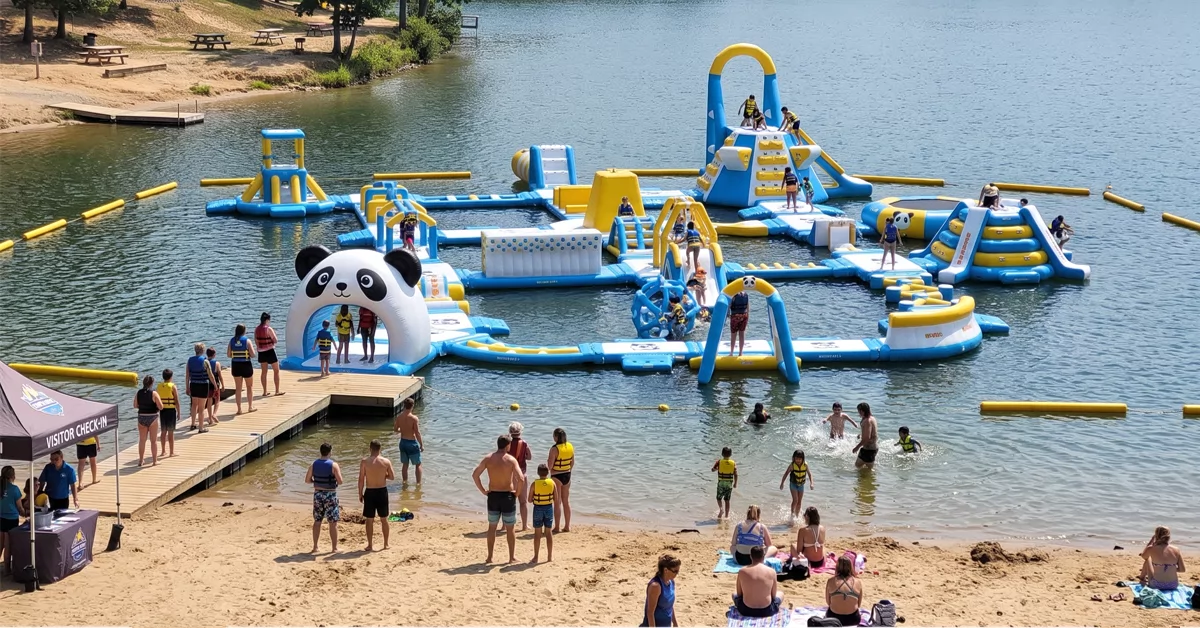
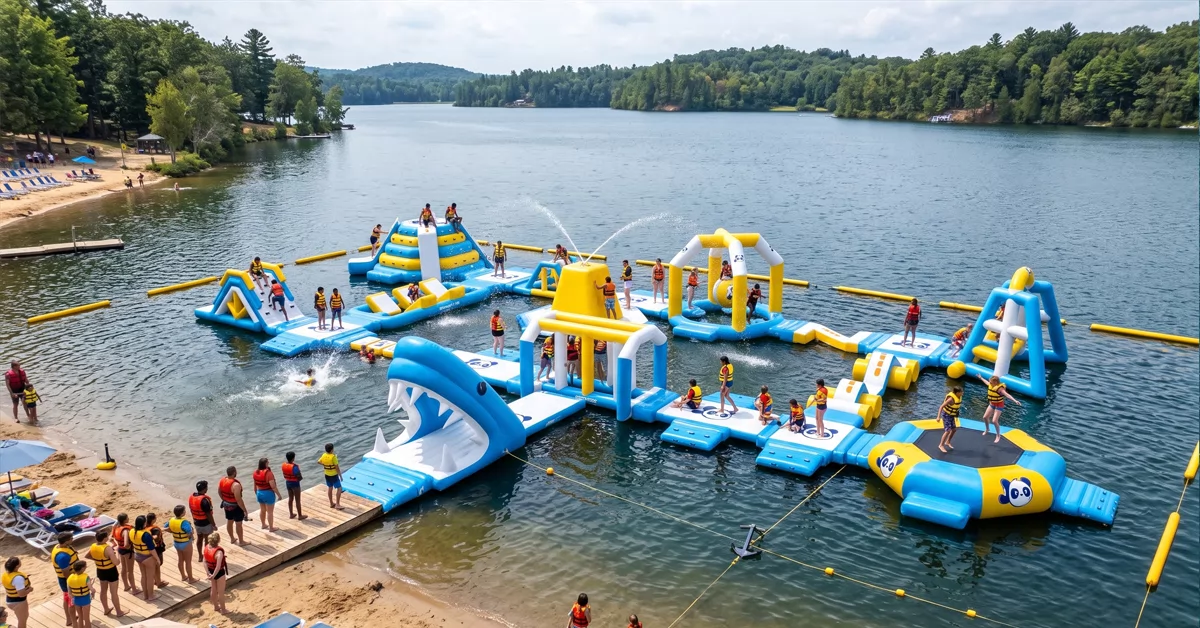
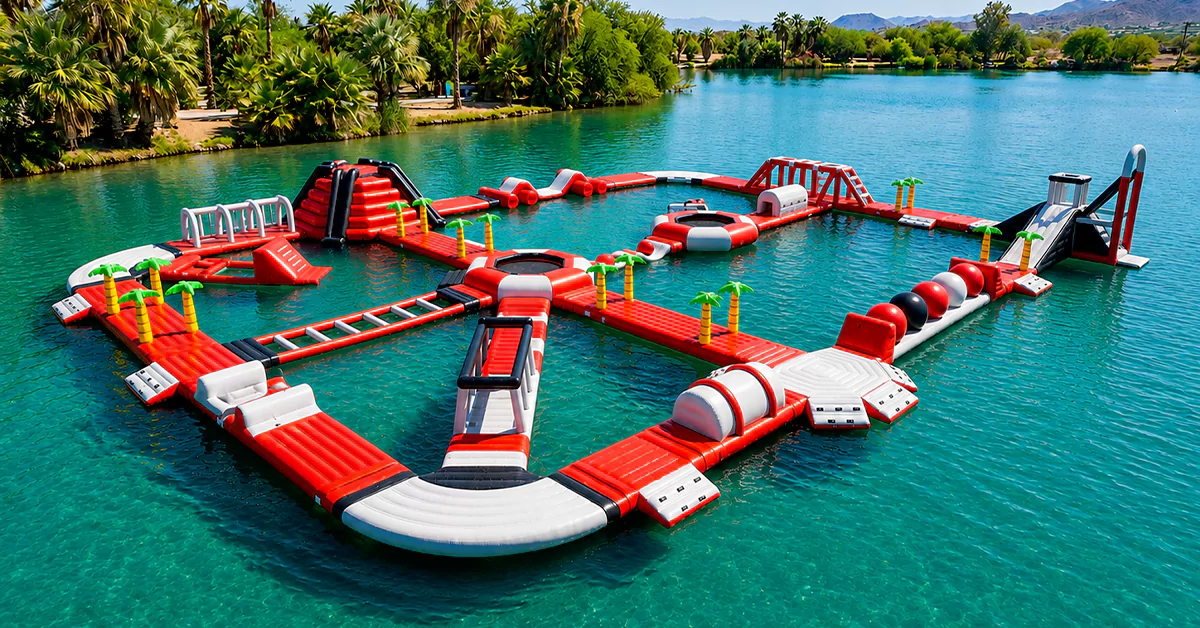
Waterfront destinations face a tough balance: maximising guest excitement while keeping upfront capital, space disruption and staffing lean. Permanent water parks demand massive investment and lengthy permits. A modular inflatable water park activates open water in weeks instead of years — but "fast ROI" is a claim worth testing against arithmetic, not repeating as a slogan.
Why operators choose inflatable water attractions
- Rapid deployment. Sealed modules inflate and anchor in days, not construction seasons. A park can open inside the same summer season it was ordered.
- Scalable, modular layouts. Start with core obstacles such as climbing towers and slides, then add modules as demand proves itself. Reconfiguring the layout each season gives returning guests a reason to come back.
- Low operational overhead. Sealed modules hold pressure for weeks without continuous blower support, which cuts power draw and noise. Constant-air modules sit on the other side of that trade-off: cheaper per square metre, but they need blowers running all day. When winter arrives, every module deflates for compact off-season storage.
What ROI means for an inflatable water park
Three numbers decide the result, and only one of them is revenue:
- Gross gate revenue — visits × ticket price, capped by sessions per day and safe capacity.
- Contribution — what is left after lifeguards, insurance, power and marketing. This is the number that pays back capital.
- Capital tied up — the all-in figure, not the equipment quote.
A park that earns USD 600,000 and keeps USD 150,000 is a slower business than one that earns USD 350,000 and keeps USD 180,000. Season length sets the multiplier; weather days are what turns a good model into a bad year.
The break-even number you can calculate before you buy
Start with the only figure you control completely: visits needed to clear the capital. Every inflatable water park budget reduces to that one number, and it can be calculated before you sign anything. Our line-by-line cost breakdown puts a 2,000 m² park sized for 200 guests at once at USD 133,000–200,000 all-in. Divide that by your ticket price:
| Ticket per visit | Gross visits to recover USD 133,000 | Gross visits to recover USD 200,000 |
|---|---|---|
| USD 15 | 8,867 | 13,333 |
| USD 20 | 6,650 | 10,000 |
| USD 25 | 5,320 | 8,000 |
| USD 30 | 4,433 | 6,667 |
Over a 100-day season, a USD 20 ticket needs roughly 67–100 visits a day just to clear the capital. That is a floor, not a payback date: it counts gross gate revenue only, before lifeguards, insurance and power. Real payback is contribution against the same capital, which is why the operators who recover fastest are rarely the ones with the cheapest build.
The three levers that move payback
Ticket price. A two-hour session at USD 25 instead of USD 20 cuts the break-even visit count by a fifth. Price against local alternatives, not against cost.
Utilisation. Sessions per day × safe capacity × realistic fill rate. Capacity is set by the park size that matches your water area — an oversized inflatable water park on a site that fills a third of it is the most common capital mistake we see.
Season length. Every extra week of operation spreads the same capital over more visits. Where the water stays warm longer, an inflatable water park keeps earning while concrete parks are still in their first permit cycle.
Where the model breaks
Weather days. A ten-day closure in peak season is not a ten-day dip; it is unrecoverable capacity. Budget the season at 85–90% of theoretical days.
Capacity creep. Operators add guests to a session until supervision gets thin. Insurance and incident risk move faster than revenue at that point.
Staffing ratios. Lifeguard cover is a fixed cost that scales with water area, not with ticket sales. It is the line most often missing from a first-season model.
Financing structure. A repayment schedule that front-loads instalments into the low season can sink an inflatable water park that is fundamentally profitable. The financing options compared here all turn on matching payments to the season, not on the rate.
Durability and compliance are ROI line items
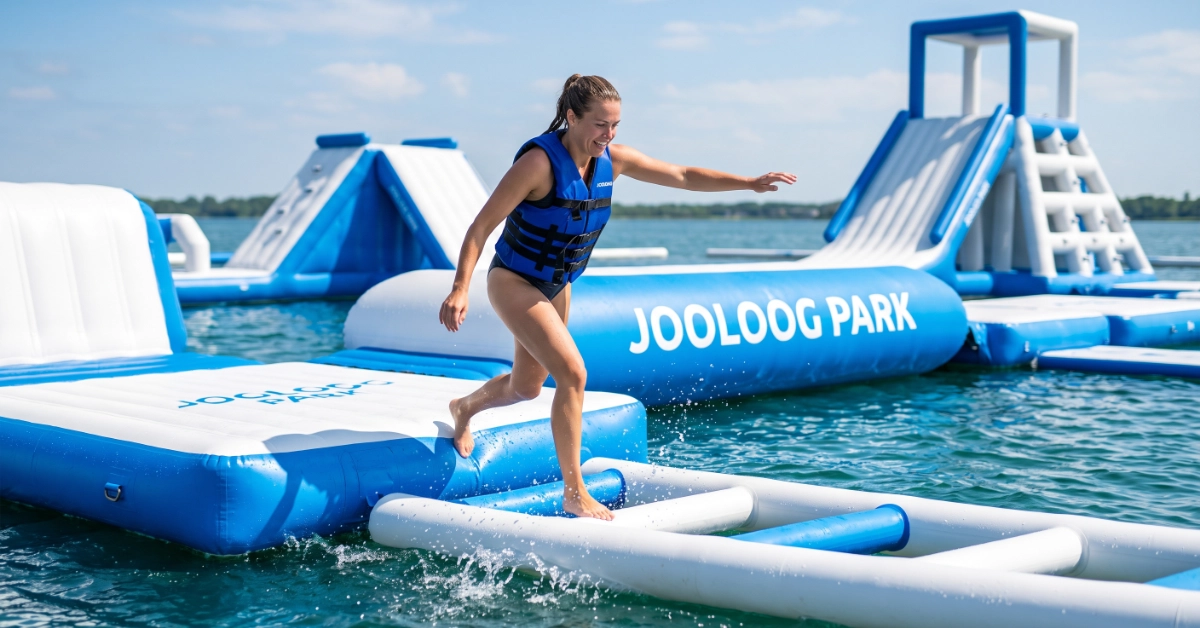
Downtime kills seasonal revenue. JOOLOOG builds each inflatable water park from heavy-duty 0.9mm UV-resistant PVC tarpaulin and drop-stitch walking decks that hold solid, wood-like stability under high foot traffic. Adherence to CE/EN15649 makes permitting and insurance compliance straightforward — and both of those are schedule costs before they are legal ones. Operators who want to see the build and test process before committing can review completed site builds on comparable water.
What to do next
Model the inflatable water park you can fill, not the one you can imagine. Start with the layout and the capacity, convert that into a capital figure, then test it against your ticket price and your realistic season. The floating aqua park module range is where most campground and resort layouts begin.
Send your site details — shoreline length, water depth, expected season — and you will get a layout, a capacity estimate and a line-by-line number to run through the arithmetic above before you commit.