Start with the number nobody quotes
Ask what an inflatable water park costs and you get one figure: the equipment. That figure is real, but it is not your budget. It is one line of five.
Operators who plan around the equipment quote alone tend to run out of money in the last month before opening. That is when mooring, insurance, staff and launch marketing all land at once.
The five lines of an inflatable water park budget
| Line | Typical share | What it covers |
|---|---|---|
| Equipment | 55–70% | Modules, blowers, anchors, matting, ladders, spare parts |
| Freight and duty | 8–15% | Ocean freight, insurance, customs, inland delivery |
| Site works | 5–12% | Mooring points, shoreline access, power, changing space |
| Installation | 3–6% | Crew, crane or boat time, commissioning, staff training |
| Working capital | 8–15% | Payroll, marketing and overhead before gate revenue stabilises |
The percentages shift with size. A small park carries a higher freight share, because a container costs the same whether it is full or half empty. They also shift with the type of modular inflatable water park you buy: a flat platform and a slide tower do not divide their costs the same way.
What actually moves the equipment price
Five variables explain most of the spread between two quotes:
- Wet surface area. Price tracks square metres far more than module count. Compare quotes per m², then check that the size you are pricing fits your site and visitor numbers.
- Towers and slides. A slide tower costs more per square metre than a flat platform, and the difference is visible in the module list.
- Blower count. Every module needs continuous air. More blowers means more cost and more power draw.
- Custom printing. Full branding adds cost and adds days.
- Certification and testing. A park with a test report costs more than one without. Ask which you are being quoted, and ask to see the test and production process behind it.
Freight, duty and the part people underestimate
A 40HQ from South China to most Northern Hemisphere ports runs about USD 2,500–6,000 depending on season, plus 15–35 days of transit. Freight is volatile, so treat any quote older than two weeks as a guess.
Duty depends on destination and HS classification. Inflatable water park articles are commonly classified under HS 9506.99, but rates change and national treatment varies. Ask your customs broker for a landed-cost estimate. Do not budget from a blog post, including this one.
Site works: small line, large consequences
This is where inflatable water park projects quietly slip. You may need seabed or shore anchors, a dredged access channel, a reinforced entry ramp, power to the blower station, and a dry area for queues and shade.
On a lake with a soft bottom, mooring design alone can reach five figures. Get a local marine contractor to quote before you sign the equipment order, and ask any supplier you shortlist for completed site builds on water like yours — a lake, a sea inlet and a pool deck fail in different ways.
Installation and commissioning
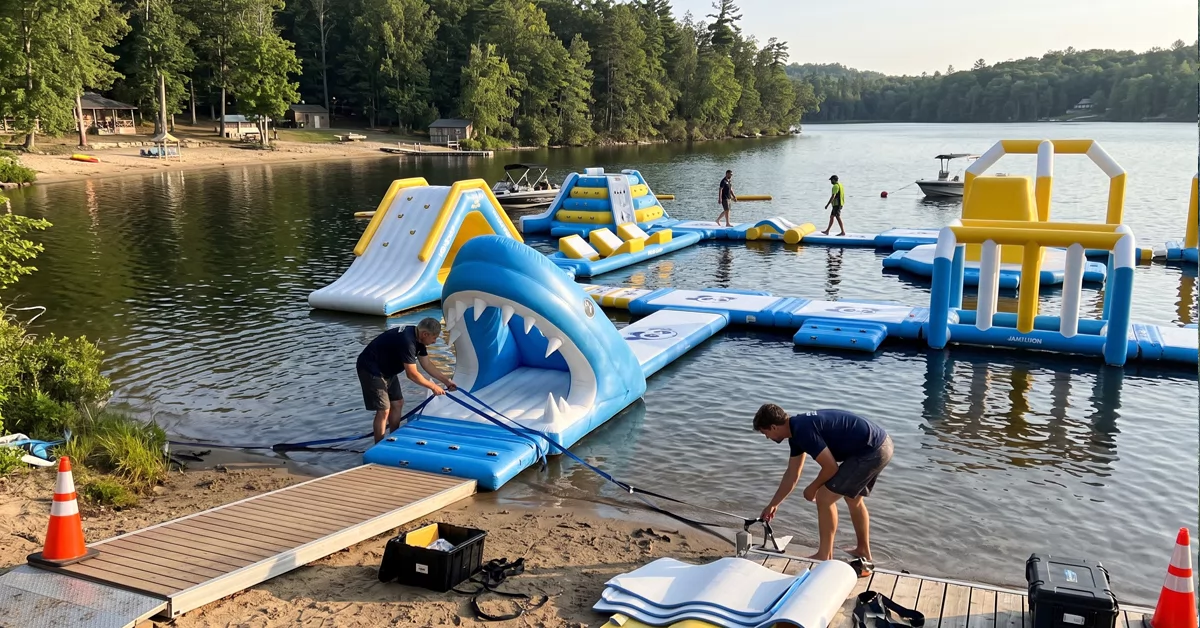
Installation is usually three to six days for a mid-size park with a trained crew. It includes unpacking, positioning, anchoring, pressure testing, blower setup and a full inflation cycle.
Budget for your own team to be on site and learning. The handover is the only free training you will get, and blower and seam support afterwards is only as good as the crew that watched the first inflation.
The line everyone forgets: working capital
You will pay staff, insurance, marketing and utilities for four to eight weeks before revenue settles. Most first-season failures are cash failures, not visitor failures.
A useful rule: hold 10–15% of total project cost as untouchable operating cash. If the all-in number is USD 160,000, keep USD 16,000–24,000 aside. If that gap is the problem, the financing routes worth comparing are narrower than most buyers expect.
A worked example
A mid-size inflatable water park sized for about 200 guests at once, roughly 2,000 m² of wet surface:
| Line | Range (USD) |
|---|---|
| Equipment | 95,000–130,000 |
| Freight, duty, inland delivery | 10,000–18,000 |
| Site works and mooring | 8,000–20,000 |
| Installation and commissioning | 4,000–8,000 |
| Working capital | 16,000–24,000 |
| All-in | 133,000–200,000 |
The number to raise is the USD 133,000–200,000 all-in figure, not the USD 95,000 equipment line. On how quickly that money comes back, see the ROI benchmarks for campgrounds and resorts.
Three ways the budget goes wrong
Site works underquoted. A marine contractor's verbal estimate becomes a written quote with a crane, a barge and a diver. Get it in writing before you order equipment.
One blower, no spare. A failed blower closes a zone. A spare on the shelf costs a few hundred dollars and saves a weekend.
No shade, no seating. Guests who cannot sit down leave earlier and spend less. Shade is a revenue line disguised as a comfort item.
How to compare two inflatable water park quotes fairly
Ask every inflatable water park supplier for the same eight items:
- Itemised module list with dimensions and wet surface per module.
- PVC specification: weight in grams and yarn denier.
- Blower count, power draw and noise level.
- Anchor type, count and holding capacity.
- Packing volume and total weight.
- Test report or certificate, and who issued it.
- Warranty terms, including seam repairs.
- Spare parts list and recommended stock.
Two quotes that look 20% apart usually differ on items 2, 6 and 8. Compare those before you compare the total.
What to do next
Send your shoreline dimensions and water depth readings before you ask for an inflatable water park quote. A layout plan drawn against your actual site will change the equipment list, and often the budget, before you commit. Send your site details and you get a layout and a line-by-line number back, not a single figure.