Why the shape of the money matters more than the rate
An inflatable water park earns most of its revenue in a few months and almost nothing in winter. A loan with flat monthly payments fights that pattern. A loan with a seasonal or balloon structure works with it.
Before comparing rates, answer one question: what does a bad weather month do to your ability to pay?
Option 1: Pay cash from reserves
Best for: established campgrounds with idle cash and a short payback horizon.
Cash is the cheapest money you will ever use, and it removes approval risk. The trade-off is concentration. Writing a USD 150,000 cheque from reserves leaves little room for a bad season or a roof repair — and the cheque size is set by the park size that fits your shoreline and visitor numbers, not by what is left in the account.
If cash is above 25% of your annual revenue, this option is defensible. Below that, keep some powder dry.
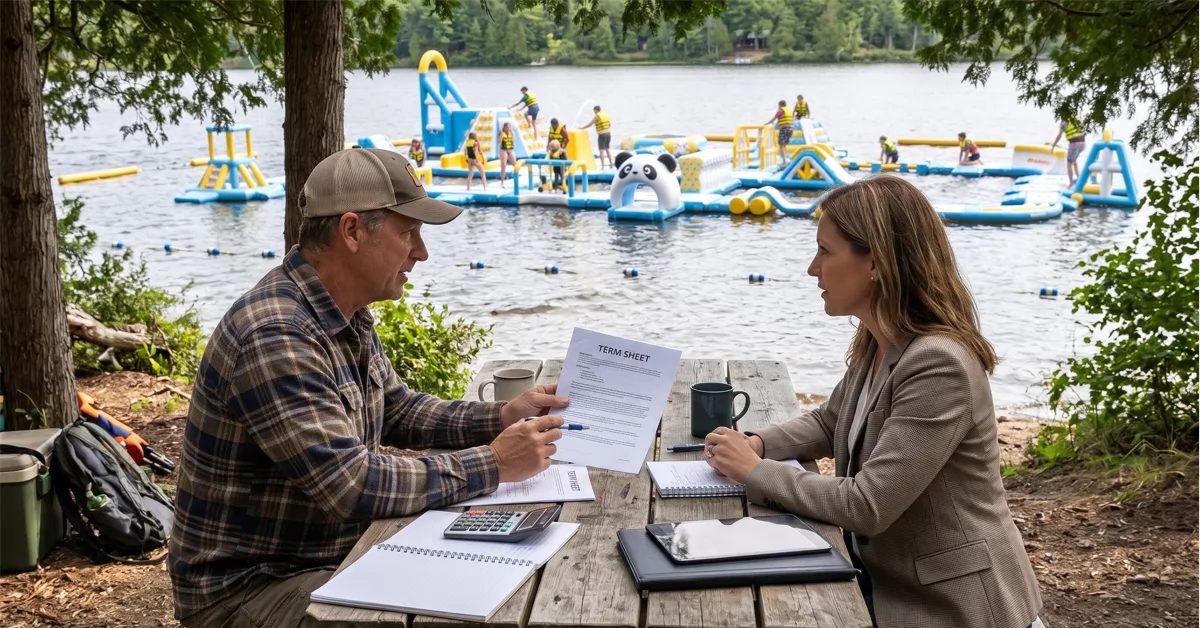
Option 2: Equipment finance for an inflatable water park
Best for: operators who want to preserve cash and can accept a fixed term of three to five years.
Equipment finance uses the inflatable water park itself as collateral, which usually means less paperwork than a property loan. Monthly payments are predictable and the asset is producing revenue while you pay for it.
Two cautions. First, check whether the agreement is a true lease or a finance agreement, because the tax treatment differs. Second, confirm that early repayment is allowed without penalty.
Option 3: Bank term loan or government-backed small business lending
Best for: operators with clean accounts, existing property and time to wait.
This is usually the cheapest borrowed money. It is also the slowest. Expect two to four months from application to funds, and expect the lender to ask for an inflatable water park business plan with seasonality built in.
Where a government guarantee scheme exists, for example the SBA 7(a) programme in the United States or similar national schemes elsewhere, it can reduce the collateral requirement. Eligibility rules are strict and change, so start with your own bank rather than a broker's website. Banks also underwrite comparables, so have completed site builds on water like yours ready to show.
Option 4: Partner or revenue share
Best for: landowners with a great site and no capital.
A partner funds the inflatable water park and takes a share of gate revenue for an agreed period, often three to five years. You keep the land, the staff and the operating licence.
The advantage is speed and shared risk. The disadvantage is that a good park becomes expensive over time. Model the total amount you will hand over across the term, not just the percentage.
Side by side
| Option | Capital needed upfront | Speed | Cost | Main risk | Fits |
|---|---|---|---|---|---|
| Cash | 100% | Immediate | Lowest | Ties up reserves | Cash-rich campground |
| Equipment finance | 0–20% | 2–6 weeks | Medium | Fixed payments in low season | Most operators |
| Bank term loan | 10–30% | 2–4 months | Low | Approval and timing | Established business |
| Partner / revenue share | 0% | 4–12 weeks | Highest long term | Shared upside | Land-rich, cash-poor |
All four assume you already know the number you are financing. If you do not, start there: what an inflatable water park actually costs, line by line, including the working capital the lender will expect you to fund yourself.
Which option fits a campground
Most campgrounds sit in a specific spot: they own or lease land with water access, they have steady summer revenue, and they have limited free cash.
That profile points to equipment finance with a seasonal repayment schedule, or a bank loan if the campground has three years of clean accounts. Cash works only when reserves are genuinely surplus. Before you sign, test the payback against your own gate revenue rather than a lender's generic model — the ROI benchmarks for campgrounds and resorts are a better starting point than a rate sheet.
The one rule that saves deals
Never let the first repayment fall due before your first full season closes.
Structure the facility so payments start in month nine or later, or build an interest-only period into the first year. A park that opens in May should not face its first instalment in June.
Ask three questions before you sign
1. What happens if a session season is lost to weather or a closure order?
2. Can payments be suspended or deferred once, without penalty?
3. Does the lender or lessor require named insurance, and who pays for it?
Get those three answers in writing. They matter more than 0.5% on the rate.
What to do next
Price the project before you price the money. Equipment is only 55–70% of the all-in cost of an inflatable water park; freight, site works, installation and the cash you need to trade through month one make up the rest, and a lender will underwrite the whole project, not the container list.
Then match the asset to the facility. If the layout is still open, the modular inflatable water park range is where most campground projects start.
Send your site details and you will get a layout and a line-by-line number back — the two documents a lender will actually ask for.