An inflatable water park spends its life in the two environments that destroy PVC fastest: standing in water, and sitting in the sun. Everything in this guide comes down to one idea — the work you do in twenty minutes a day decides whether a module lasts five seasons or twelve.
Why regular cleaning matters
An inflatable water park is never clean for long. Seven things attack the surface continuously, and each one fails differently:
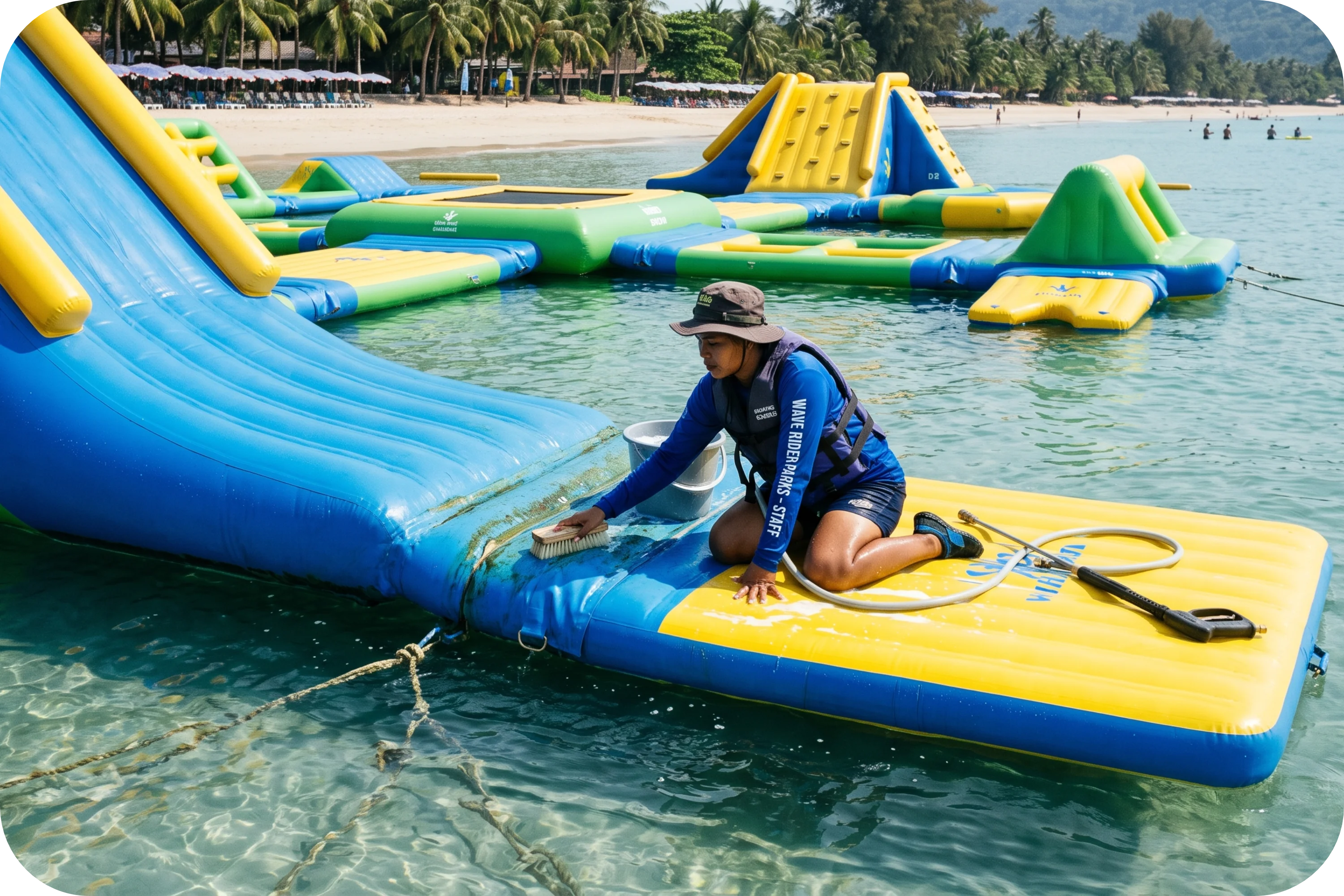
- Algae — establishes in seams, folds and shaded undersides first; a colonised surface stops being grippy.
- Saltwater — leaves crystalline residue that grinds against seams every time a guest steps across a joint.
- Chlorine — keeps water clean but degrades the plasticiser in PVC on prolonged contact, which is what makes old inflatables stiff and brittle.
- UV rays — the single biggest cause of colour fade and surface hardening; nothing reverses it, you can only slow it.
- Sand and dirt — works into seams, valve caps and strap buckles and acts as an abrasive.
- Bird droppings — acidic enough to etch the coating, and the mark sets within days if left.
- Organic debris — leaves and twigs hold moisture flat against the surface, and that trapped moisture is where mold starts.
None of these produces a dramatic failure. They produce a slow decline in grip, colour and air retention, and then a repair bill that arrives in your busiest month. Routine work protects four things that cost real money: the surface itself, the safety of the deck underfoot, the appearance guests judge you by, and the resale value of the asset.
Maintenance also protects revenue directly. A module out of service in August is not a repair cost, it is lost capacity at peak ticket price — the same arithmetic that decides how fast a park pays for itself.
The maintenance schedule: daily to end of season
Before opening each day, walk every module of the inflatable water park. This is not a cleaning task, it is a safety check that happens to keep the park clean. Check for:
- Air pressure — a soft module sits lower, drains poorly and moves underfoot. Inflate to the pressure in your manual, never by feel.
- Loose anchor points — the most common cause of a module drifting out of alignment mid-session.
- Valve condition — caps seated, no hiss, no sand in the thread.
- Connecting straps — frayed webbing and bent buckles both fail suddenly with guests on them.
- Surface scratches and dirt — shallow marks clean up; deep ones need patching before they spread.
- Floating stability — push down on each corner. A module that rocks has a baffle or pressure problem.
Clear leaves, branches and litter with a soft brush or sponge before guests arrive. In saltwater, rinse with fresh water as often as your setup allows — weekly at minimum, daily if you have a hose at the dock.
| Frequency | Task | What you are actually looking for |
|---|---|---|
| Daily | Walk every module, remove debris, check pressure | Soft modules, loose anchors, new damage |
| Weekly | Wash surfaces, inspect connectors | Algae film starting in seams, chafed straps |
| Monthly | Deep clean, inspect valves | Staining, valve wear, seam lifting |
| Every season | Full structural inspection and repairs | Leaks, delamination, anchor system wear |
| End of season | Deep clean, dry, repair, store | Anything that will worsen over winter |
Understanding algae growth
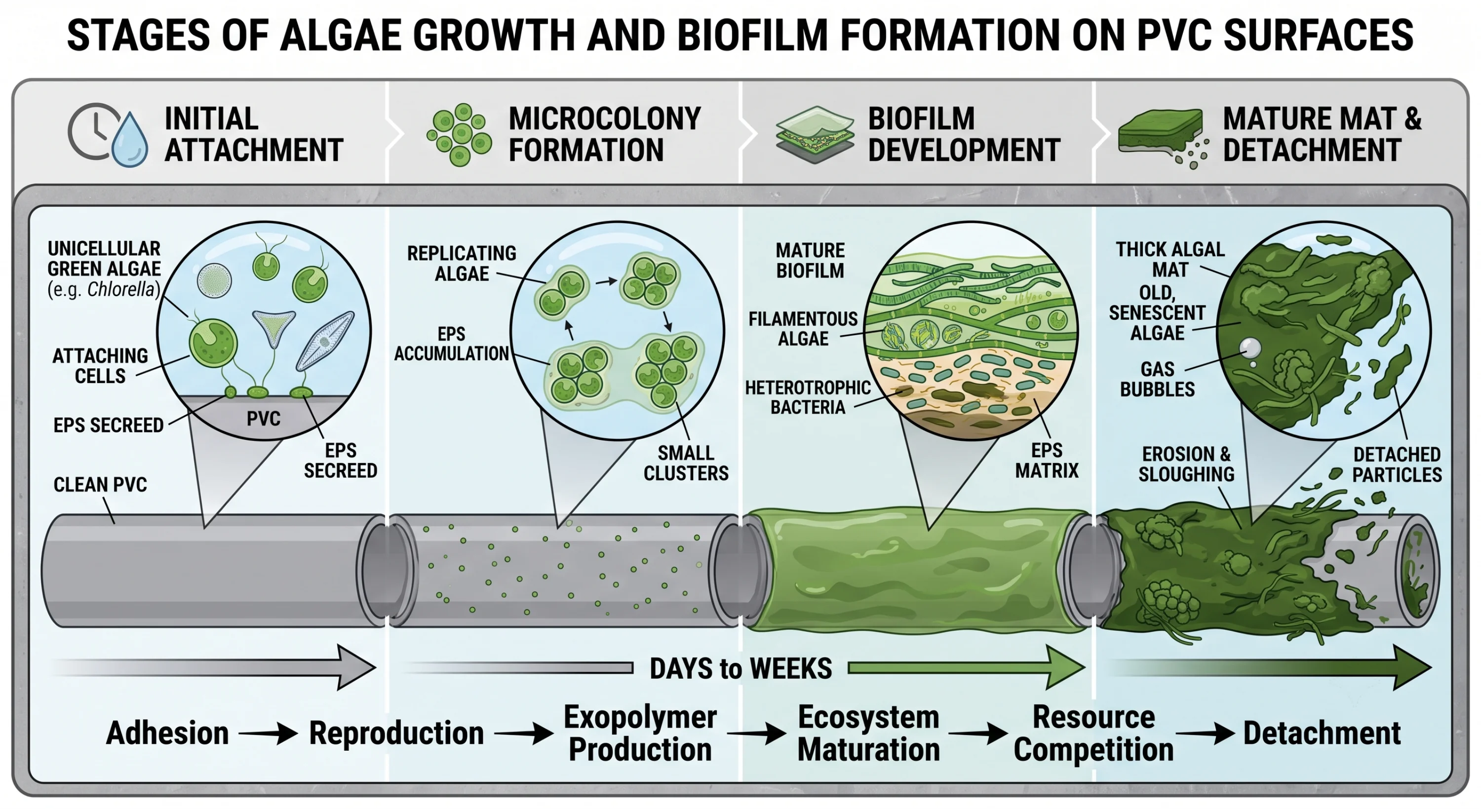
Algae is the maintenance problem that compounds fastest on an inflatable water park, because each stage makes the next one harder to remove. It moves through three stages:
- Green surface film — a slippery layer you can wipe off with a sponge and mild cleaner. Half an hour of work.
- Dark algae stains — the film has bonded into the coating. Needs a PVC-specific cleaner and repeat applications, and the colour may never fully return.
- Thick biological buildup — textured growth in seams and on undersides, holding water against the material. This is a labor job, and it is where mold starts.
The practical rule: deal with it at stage one. The cost difference between wiping a film and removing a buildup is measured in days of labour, not hours — and stage three damage is permanent enough to show up in how the park photographs.
Recommended cleaning equipment
Cleaning an inflatable water park starts with tools that are gentle by design. You need:
- A soft sponge and a soft-bristle brush for flat surfaces and seams
- Microfiber cloths for drying and for valves
- A fresh water hose, and a low- to medium-pressure washer
- An approved PVC cleaner and a PVC protectant
- Protective gloves and safety goggles — the cleaners are mild, but the algae is not something to handle bare-handed all day
Just as important is what stays in the shed. Do not use strong acids, household bleach, industrial solvents, metal brushes or abrasive pads. Bleach is the most common mistake: it is far stronger than pool water ever is, and it strips the plasticiser out of the coating, which is the exact ageing process you are trying to prevent. A surface cleaned with bleach looks bright for a month and then fails early.
Step-by-step cleaning process
Work module by module. Cleaning half an inflatable water park properly beats rinsing all of it.
Step 1 — Move the module to shore
Bring the module onto land, disconnect the connecting straps, secure the sections you are not working on, and lay the unit on a clean tarp. Cleaning in place looks faster and is not: everything you lift off the surface goes straight back into the water beside it.
Step 2 — Initial rinse
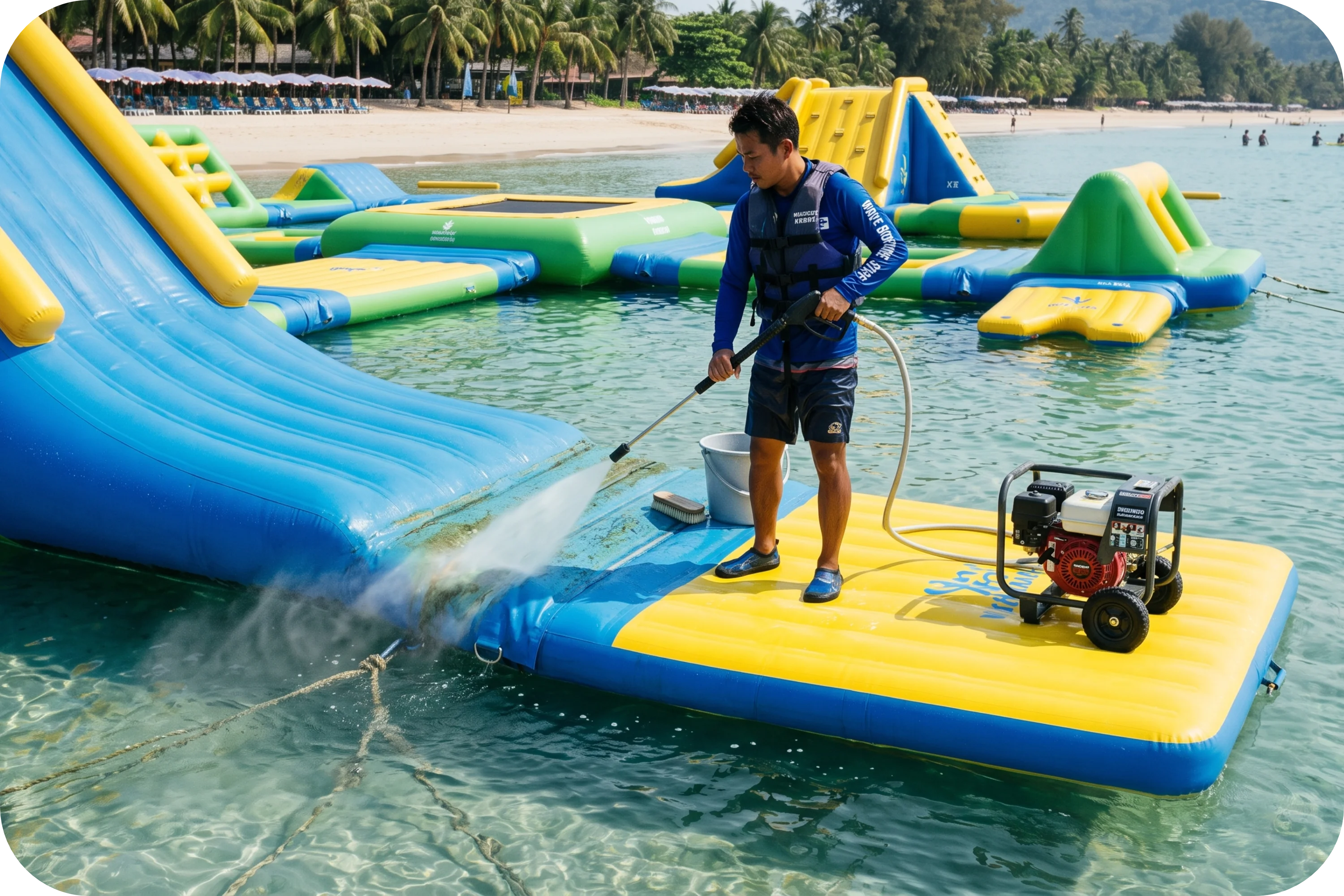
Rinse the whole surface with clean water to remove sand, mud, dust and loose organic matter. Keep the nozzle at a sensible distance — held close, a pressure washer drives grit into seams and can lift the coating at the edge of a print. Follow the distance stated in your washer's specification.
Step 3 — Remove dirt and algae
Apply an approved PVC cleaner and work section by section with a soft sponge, giving seams and high-traffic areas the most attention. Never let a cleaner sit longer than its instructions allow, and rinse thoroughly afterwards — residue left in a seam keeps working on the material long after you have moved on.
Step 4 — Dry completely
Let the module dry naturally until no standing water remains and seams, folds and valves are dry to the touch. In humid weather this takes longer than the surface suggests. This step is the one that gets skipped and the one that causes mold in storage.
Step 5 — Apply PVC protection
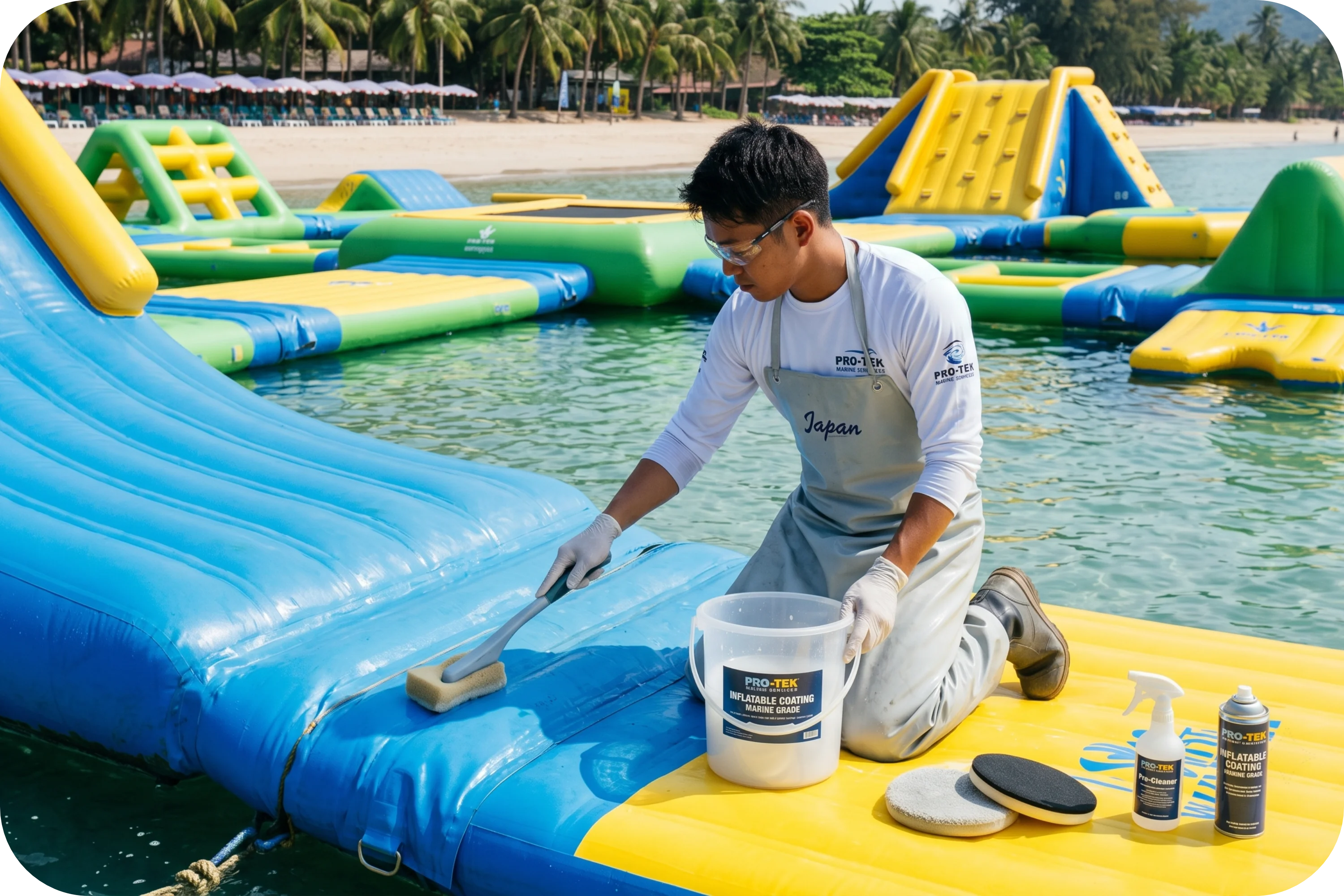
Once dry, apply a professional PVC protectant. It slows UV ageing, holds colour, makes the next clean easier and keeps the material supple. Protection is not cosmetic — flexibility is what stops a seam from cracking when the module flexes under a guest.
Seasonal deep maintenance and when to replace
At least once every season, inspect the whole inflatable water park properly: air leaks, worn seams, damaged handles, loose D-rings, anchor system wear, surface discolouration and valve performance. Repair small faults immediately — a pinhole is a patch, and a pinhole left for a season is a seam rebuild.
Not everything is worth repairing, though. Patch, re-glue or replace hardware when the damage is local: a hole, a torn handle, a failed D-ring, a leaking valve. Replace the module when the material itself has gone — visible delamination between coating and base cloth, cracking along a seam line, a surface that stays stiff after inflation, or a repair that has already failed twice in the same place. If you are replacing rather than repairing, match the new unit to your existing connector spacing before you order, and check it against the current floating aqua park module range. A worn module also costs you capacity and safety margin, so the comparison is not repair cost against replacement cost; it is replacement cost against the revenue the module earns. Our technical support team will tell you which of the two you are looking at from photographs.
Proper storage
For an inflatable water park, storage decides how much of the season's damage is permanent. Before the park goes away, clean it thoroughly, dry it completely, check for damage and repair anything you find — a fault stored for four months becomes a bigger fault.
Store in a cool, dry, ventilated place away from direct sunlight, rodents and sharp objects. Two habits matter more than the room: never fold along the same crease two years running, because repeated creases become permanent cracks; and never store a module that is even slightly damp, because that is the condition mold needs.
Common maintenance mistakes
On an inflatable water park, most premature failures trace back to six habits:
- Storing while still wet — mold establishes in weeks and reaches the base cloth.
- Using harsh chemicals — bleach and solvents strip the plasticiser and accelerate the ageing you are trying to stop.
- Dragging inflatables across rough ground — abrasion on the underside is invisible until it leaks.
- Ignoring small leaks — water enters the shell, and a wet interior cannot be repaired properly.
- Overinflating modules — seams take the load, and heat expands the air further.
- Skipping routine inspections — every other item on this list is caught by a twenty-minute daily walk.
Conclusion
Cleaning is not about appearance. It is the cheapest form of asset protection available to a water park operator: it preserves grip underfoot, slows UV ageing, prevents mold in storage and keeps modules earning at peak capacity instead of sitting on a dock in August.
The routine is deliberately unglamorous — walk it daily, wash it weekly, inspect it seasonally, store it dry. JOOLOOG has built commercial inflatable water parks for over 25 years, and the parks that reach a second decade are not the ones with the best materials. They are the ones with the most boring maintenance logs.
If you are unsure whether a module needs a patch or a replacement, send us photos and your operating conditions — we will tell you what we would do with our own park.