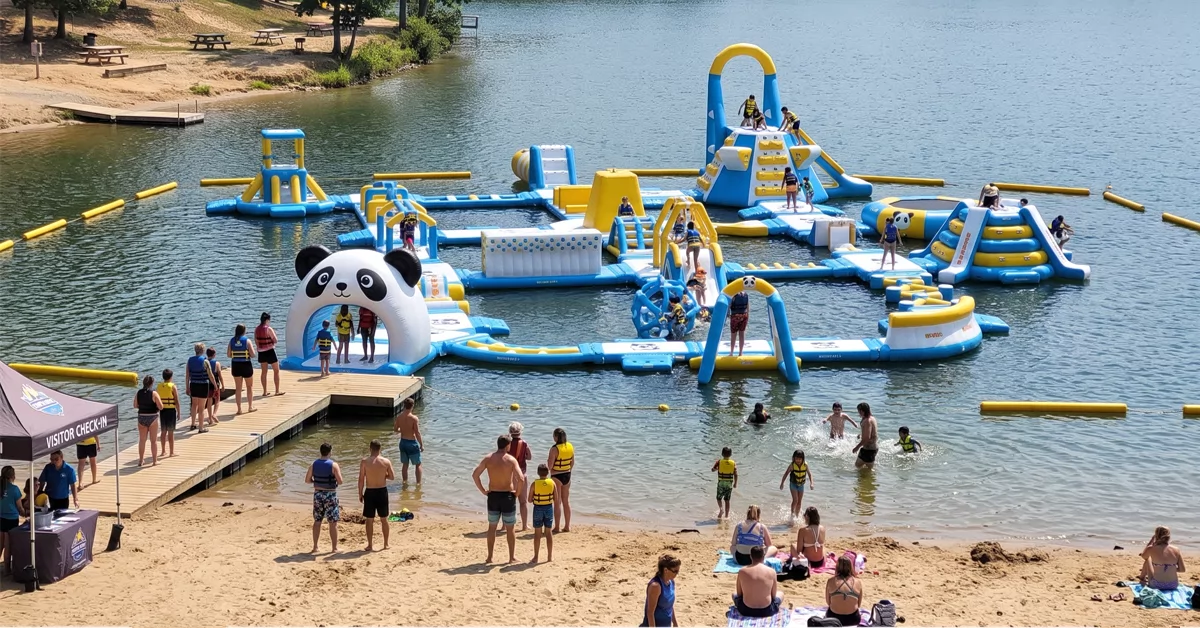
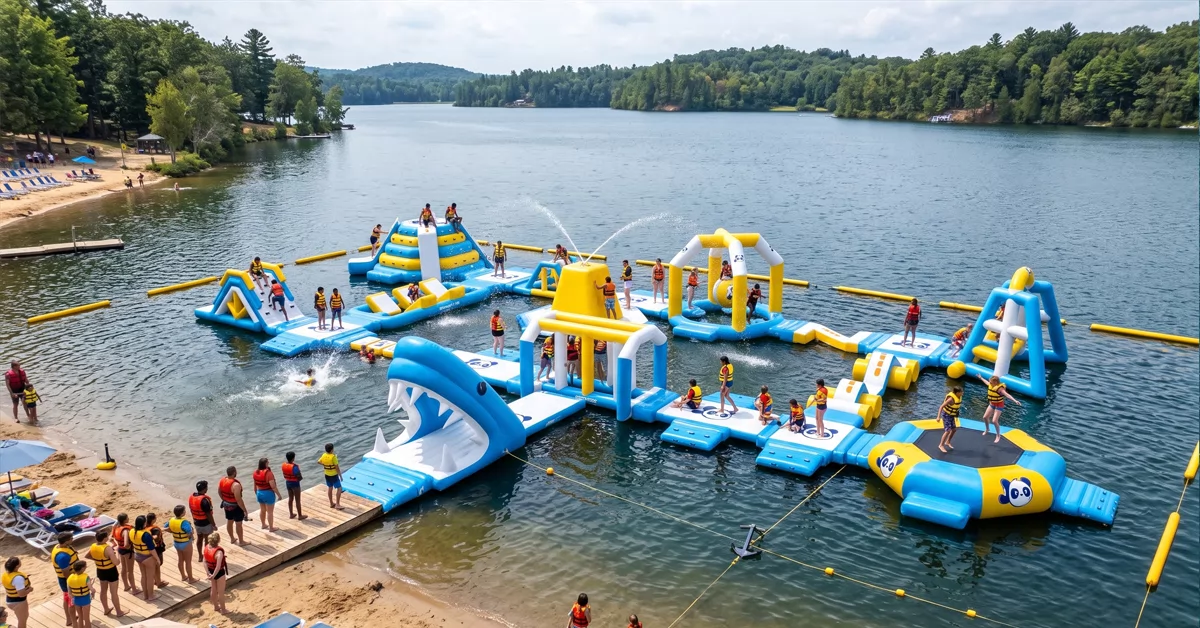
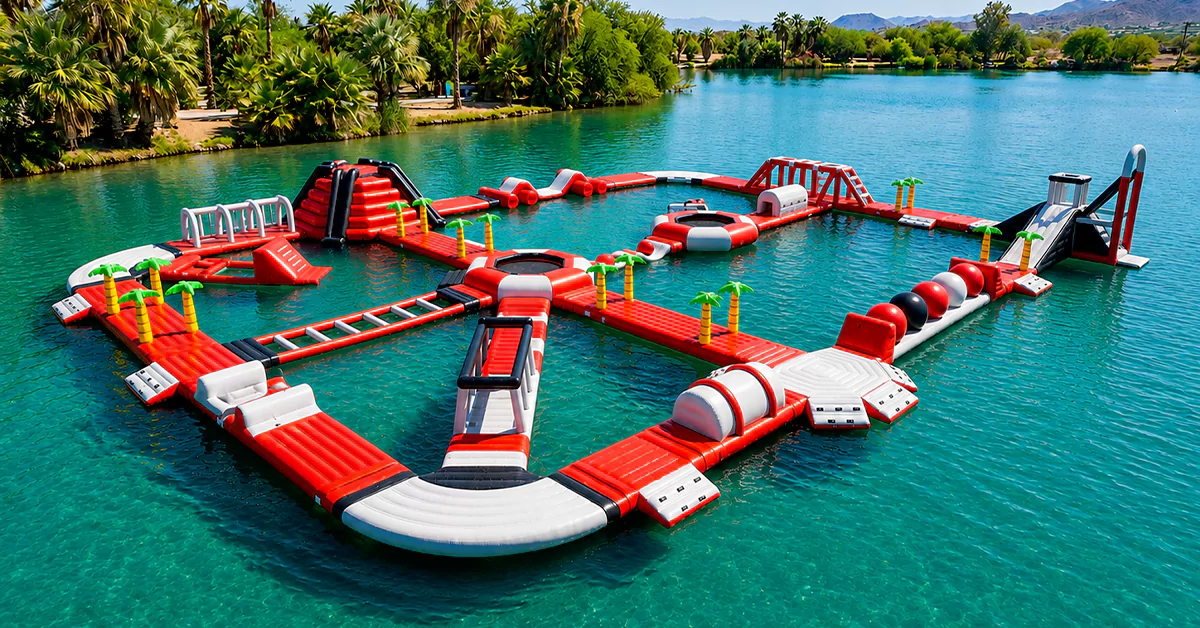
Most ROI conversations about water attractions go wrong in the first sentence, because they compare an inflatable water park to a concrete one. They are not the same asset. A concrete park is a construction project with a fixed site and a sunk cost. A commercial inflatable water park is movable equipment that can be deployed, refreshed, relocated or sold. That difference changes what "return" means, and it changes which numbers matter.

1. Why the economics of a floating attraction differ
The commercial recreation market is shifting toward dynamic, mobile experiences. For beach resorts, waterfront developers and commercial investors, a traditional concrete water park means millions in capital, a multi-year permit cycle and permanent environmental disruption to the shoreline.
Investing in commercial inflatable water park equipment works on a different model. Built from heavy-duty commercial-grade PVC tarpaulin with airtight welded seams, a modular park converts underused water into a revenue-generating attraction in days rather than construction seasons — and comes back out again at the end of the season, leaving the shoreline as it was.
Three consequences follow, and they are the reason the payback maths looks so different:
- The capital is recoverable. Equipment can be sold or moved to another site; a concrete basin cannot.
- The permit burden is lighter, because nothing permanent is built into the water body.
- The asset can be re-shaped. Modules can be added, replaced or re-themed as demand changes, without a new capital round.
2. What the equipment costs, and what it costs per season
Start with a real number rather than a range pulled out of the air. In our line-by-line cost breakdown, a 2,000 m² inflatable water park sized for about 200 guests at once carries an equipment line of USD 95,000–130,000. That is roughly USD 48–65 per m² of wet surface. It covers the modules themselves — slides, climbing towers, decks and connecting paths — as listed in the modular floating aqua park range.
Per square metre is the number to compare across suppliers, because two quotes for "a park for 200 people" can describe very different amounts of water. But the number a CFO actually wants is the capital consumed each season:
| Service life | Capital consumed per season (USD 95,000) | Capital consumed per season (USD 130,000) |
|---|---|---|
| 5 seasons | 19,000 | 26,000 |
| 8 seasons | 11,875 | 16,250 |
| 10 seasons | 9,500 | 13,000 |
This is capital only — it excludes maintenance, site works and the working capital you need to trade through month one, all of which sit outside the equipment line. But it reframes the decision. The question stops being "can I afford USD 130,000" and becomes "can this park earn USD 13,000–26,000 a season before I have even paid for maintenance". Most operators can answer that in an afternoon.

3. Where the operating money actually goes
Opex is where inflatable parks separate from permanent ones, and it is usually under-modelled at the proposal stage:
- Staffing — lifeguards and gate staff, scaled to the number of supervised zones rather than to the size of the build.
- Insurance — a fixed seasonal line that depends on your jurisdiction, supervision plan and documentation. Compliance paperwork is not administrative overhead; it is what makes the premium affordable.
- Power — airtight drop-stitch structures hold pressure for extended periods, unlike continuous-blower inflatables that draw power every hour the park is open. On a 100-day season with long opening hours, that difference is a recurring line item, not a rounding error.
- Spares and repairs — patches, valves, straps and the occasional module, ideally budgeted as a percentage of the equipment line rather than discovered as they happen.
- Winterising — the park deflates and stores. You are not heating, filtering or guarding a structure through the off-season.
4. The revenue side: capacity, ticket and days
Revenue is not one number either. An inflatable water park earns by selling the same water several times a day, so the drivers are simultaneous capacity, sessions per day and operating days — multiplied by what you charge.
That makes payback a three-lever problem:
- Capacity — how many guests the layout holds safely at once, which is usually lower than the design figure your supplier quotes.
- Turnover — sessions per day, and whether your gate and changing facilities can actually process them.
- Price and attach rate — ticket, plus food, photos and premium add-ons.
Rather than restate the model here, the break-even visits per season are worked through on our campground and resort page, including the gross-visits table at different ticket prices.
Attach rate is the lever most resorts underuse. Pairing the obstacle park with premium amenities — an inflatable water scooter or shaded party cabanas on the deck — lifts revenue per guest without adding water area, and turns a kids' attraction into a multi-generational destination where parents stay and spend.
5. Durability is a revenue line, not a spec sheet item
In a commercial setting, an inflatable water park's downtime does not show up as a repair bill. It shows up as capacity you cannot sell. A module out of service for five days of a 100-day season removes 5% of that module's earning capacity, in the weeks when demand is highest and the ticket price holds.
That is the argument for the specification, not the price:
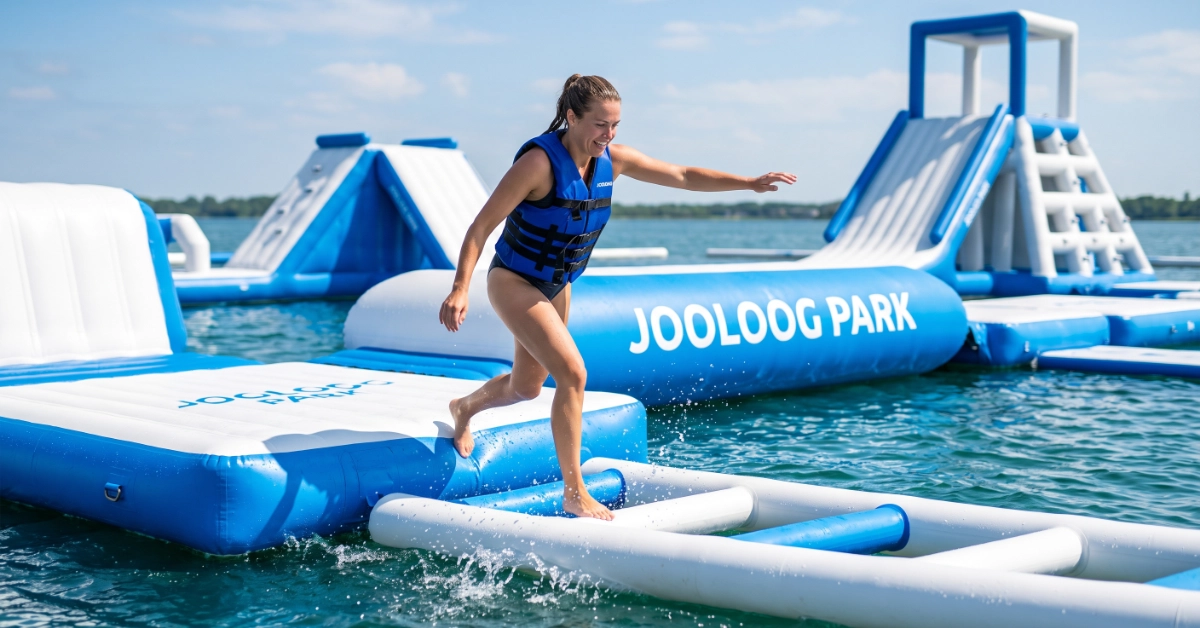
- 0.9 mm heavy-duty PVC tarpaulin — resists UV, salt water and high daily passenger loads.
- Drop-stitch decking rated for 5–8 PSI — gives a platform the rigidity of a solid deck, which is what guests feel underfoot and what reduces the rolling motion that wears seams.
- Modular construction — a damaged unit is swapped rather than shutting the park, and the layout can be refreshed each season to bring back repeat visitors.
- EN15649 and CE compliance — the documentation insurers and local authorities ask for, and the difference between a park that can open on schedule and one that cannot.
6. The payback claim, stated honestly
You will read that inflatable water parks pay back within a single season. Sometimes they do — a resort with an existing guest base, a strong ticket price and a site that needs no marine works can clear USD 95,000–130,000 of equipment in one summer. But it is not a property of the equipment. It is a property of the site, the price and the number of days you can open.
So treat payback as an output, not a promise. Fix the capital per season from the table above, fix your realistic visitor numbers, and the payback period falls out of the arithmetic. If the answer is uncomfortable on paper, it will be uncomfortable in August too.
Conclusion: build the model before you build the park
Commercial inflatable water park equipment is attractive because it converts capital into a movable, re-shapeable, seasonally removable asset instead of a permanent structure. That is a real advantage — but it only pays if the numbers behind it are yours rather than a supplier's.
Ready to model it for your site? Send us your water area, guest profile and target ticket price, and our engineering team will come back with a 3D layout, factory-direct pricing and an ROI model built on your figures rather than a template.