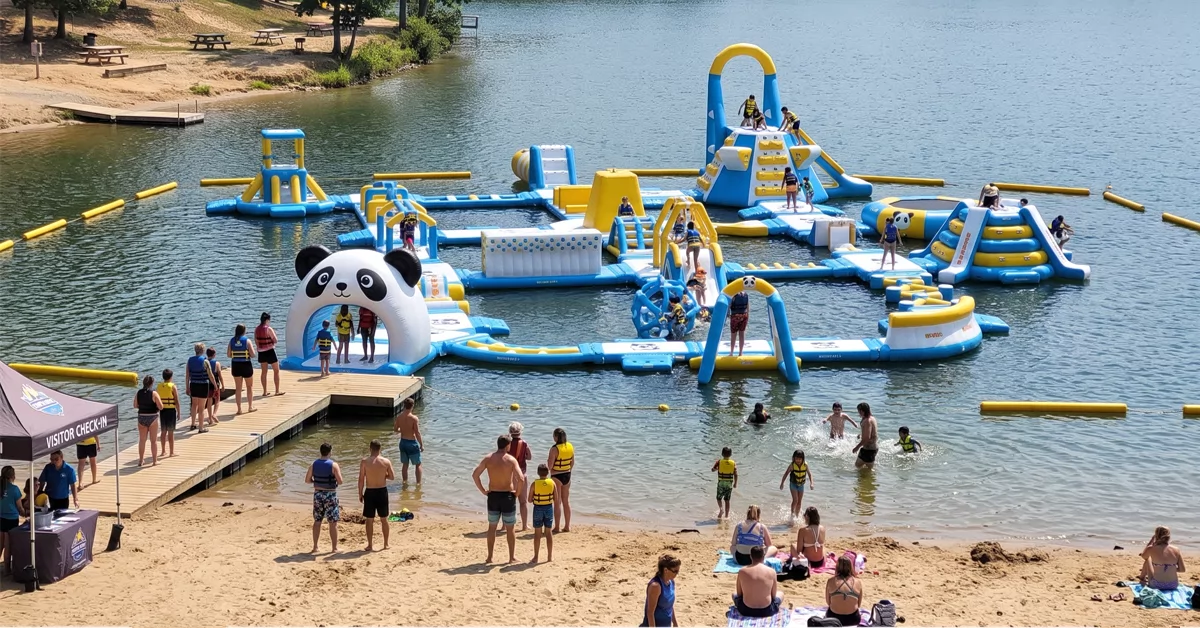
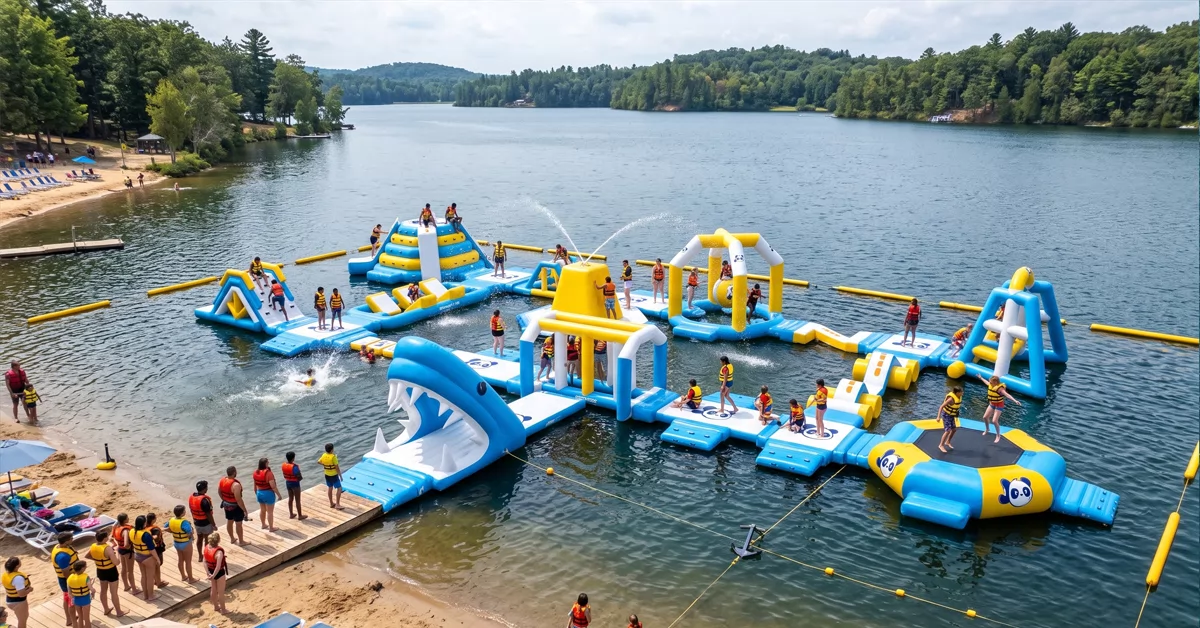
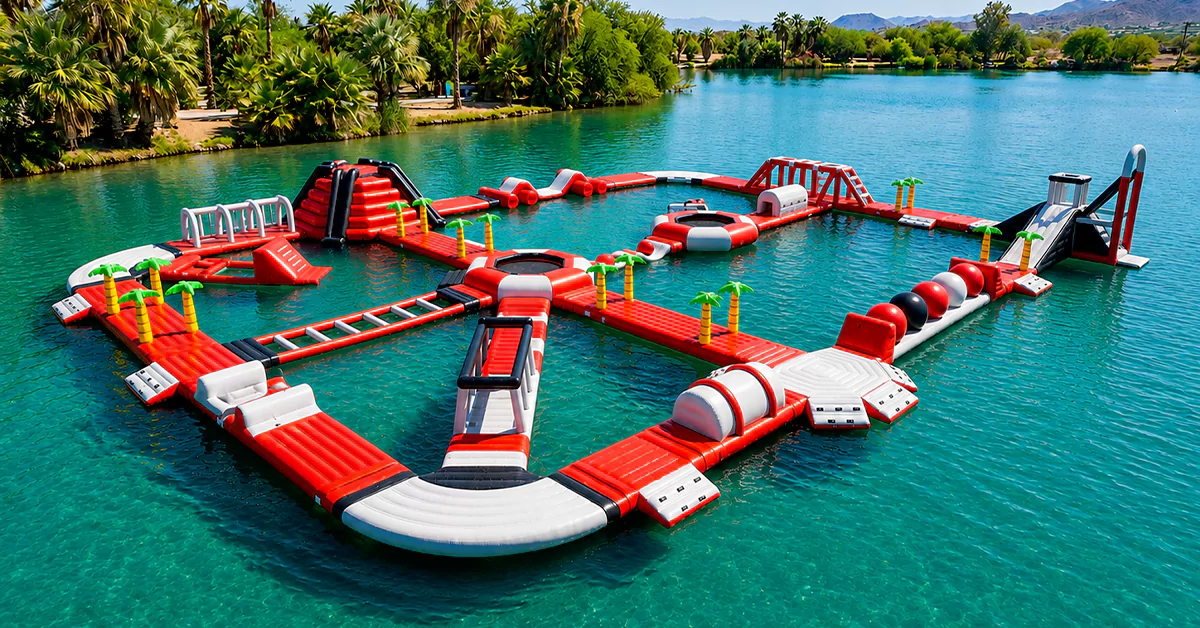
By the time an operator asks how to boost summer revenue, the decision to buy has usually been made. The harder question starts on day two of the season: you own an inflatable water park, the summer weather is good, and the gate is not producing what the business plan promised. That gap is almost never about the equipment. It is about the five numbers underneath it.

1. Where summer revenue actually comes from
Strip away the marketing language and an inflatable water park earns like this:
Revenue = visits × revenue per visit, where visits = capacity × sessions × operating days × fill rate.
Every lever you can pull sits inside one of those five terms. That is why most "boost your revenue" advice is useless — it never says which term it is moving, or by how much. Work the worksheet below once with your own numbers, and you will know where your ceiling actually is:
| Line | How to calculate it | Your figure |
|---|---|---|
| Comfort capacity | Guests the layout holds safely at once — usually below the design figure | |
| Sessions per day | Bookable slots, set by session length and daylight | |
| Operating days | Sellable days in the season, not calendar days | |
| Visit potential | Capacity × sessions × days | |
| Realistic visits | Visit potential × your honest fill rate | |
| Gate revenue | Visits × average ticket | |
| Attach revenue | Visits × spend per guest on site | |
| Season revenue | Gate + attach |
Two things usually become obvious. First, the fill rate is where the optimism lives — most plans assume a peak Saturday every day. Second, attach revenue is almost always the biggest unclaimed line, because it needs no additional water and no additional lifeguard.
2. Price the session, not the day
A mobile inflatable water park sells the same water several times a day, which makes flat day-pricing a wasted opportunity. If every session costs the same, your best hours are subsidising your quietest ones.
| Session | Who books it | Pricing logic |
|---|---|---|
| First morning slot | Families with young children, hotel guests | Full price — highest perceived value, coolest water |
| Midday | Walk-ups and peak holiday demand | Full price, and the slot to cap first |
| Late afternoon | Teenagers, repeat visitors, locals | Discount to convert unused capacity into cash |
| Evening / pre-opening | Private groups and parties | Premium per head with a minimum spend |
Two rules make this work. Never discount a session you can fill at full price, and keep the discount legible — a clearly cheaper late session reads as a smart choice, while a permanent "sale" on the same product all summer reads as desperation.
3. Fill the hours you already pay for
The cheapest revenue in an inflatable water park is the capacity you are already staffed to deliver but not selling. That means the edges of the day:
- Pre-opening private hire. A 9am slot for a school group or a corporate team costs you nothing extra in water and almost nothing in staff, and it does not cannibalise public sessions.
- After-hours parties. Birthday and community bookings convert a closed park into a premium venue. Price per head with a minimum spend, and keep the group below a third of comfort capacity so it still feels exclusive.
- Shoulder-day packages. Weekday deals for local families and camp groups flatten the weekly curve, which protects your weekend premium instead of eroding it.
The test for any of these: does it use capacity that would otherwise be empty? If yes, almost any margin is incremental. If it displaces a full-price session, you have simply discounted.
4. Attach revenue that needs no more water
Once an inflatable water park is full, gate revenue is capped. Attach revenue is not. This is where a resort-grade inflatable water park outperforms a standalone attraction, because there is already a captive audience on site:
- Shade and seating. Shaded party cabanas convert waiting parents into paying guests, and they let a family stay for two sessions instead of one.
- A second activity. Motorised toys such as an inflatable water scooter give teenagers something to do when the obstacle course is tired, at a price point well above a day pass.
- Food, drink and photography. The three highest-margin lines on any site, and the three most often left to a vending machine.
Attach revenue is also the most defensible part of the model, because it does not depend on weather, capacity or staffing ratios. It depends on whether a guest who has already paid to get wet has anything worth buying.
5. Protect the days weather takes away
Every inflatable water park loses summer days to weather. The mistake is treating them as lost revenue and doing nothing, when most of that money can be moved rather than forfeited:
- Offer credit, not refunds. A rebookable credit keeps the cash in your business and the guest in your pipeline.
- Publish the policy before the season. A clear weather policy sells more tickets in marginal weather than a generous one announced after a complaint.
- Keep a wet-weather alternative. Even a simple indoor or covered option turns a washout into a shorter visit instead of a cancellation.
The days you cannot recover are the ones with no policy attached, which is why this belongs in the business plan rather than in the operations manual.
6. What caps your ceiling
Three operational limits decide whether an inflatable water park turns extra demand into revenue or into a queue:
- Comfort capacity. Design capacity is a supplier number. What you can sell is the number of guests who can move without the park becoming unpleasant — and overselling it costs you reviews that persist far longer than the revenue.
- Gate and changing throughput. A park that can hold 200 guests but processes 60 an hour cannot run a 100-guest session. The bottleneck is usually on land, not on the water.
- Uptime. Every module out of service is capacity you have already paid for and cannot sell. That is the argument for the maintenance routine and off-season storage discipline — they protect next season's margin as much as this one's.
If the numbers on the worksheet look thin even at full capacity, the problem is upstream of revenue: it is in the capital and running costs. The all-in cost of an inflatable water park is worth re-checking before you spend a season optimising a model that cannot work, and if you have not built yet, start with the payback model for campgrounds and resorts rather than a revenue target.

7. Conclusion: revenue is an operating discipline
The reason an inflatable water park can outperform a fixed attraction is not that it is cheaper to build. It is that it can be re-priced, re-scheduled, re-laid-out and moved while a concrete park is still waiting for permits. That flexibility only becomes summer revenue if someone uses it — session pricing, group hire, attach revenue and a weather policy are all decisions you can make this week.
If you want the numbers tested against a real layout, send us your water area, season length and current ticket price, and our team will return a 3D design and a revenue model built on your figures rather than a template.