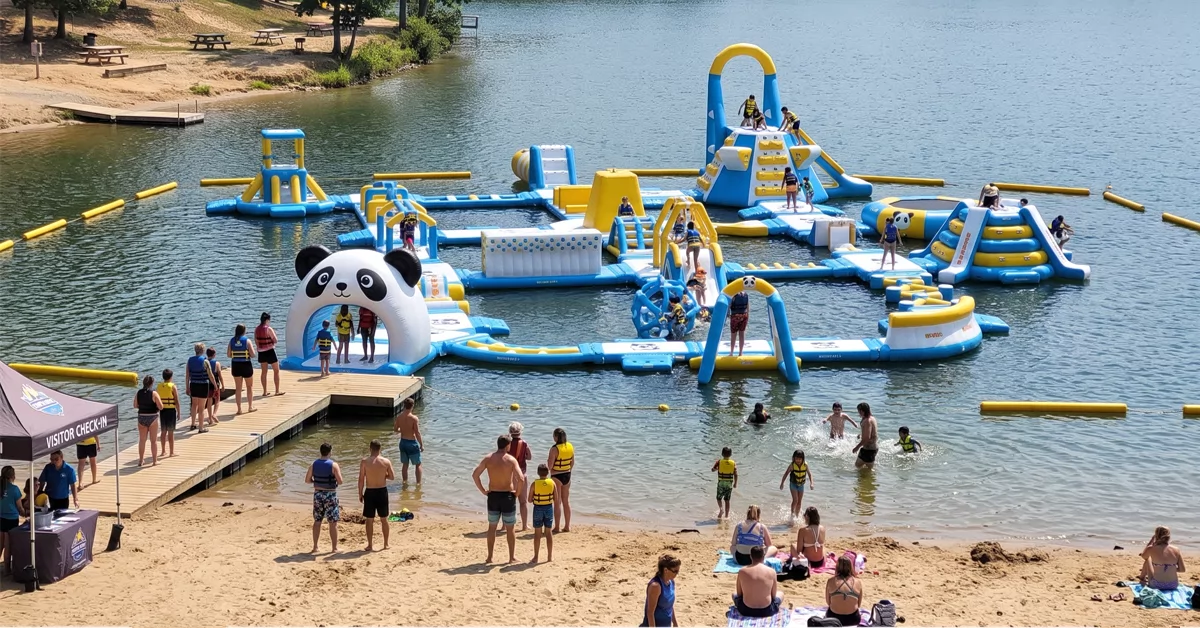
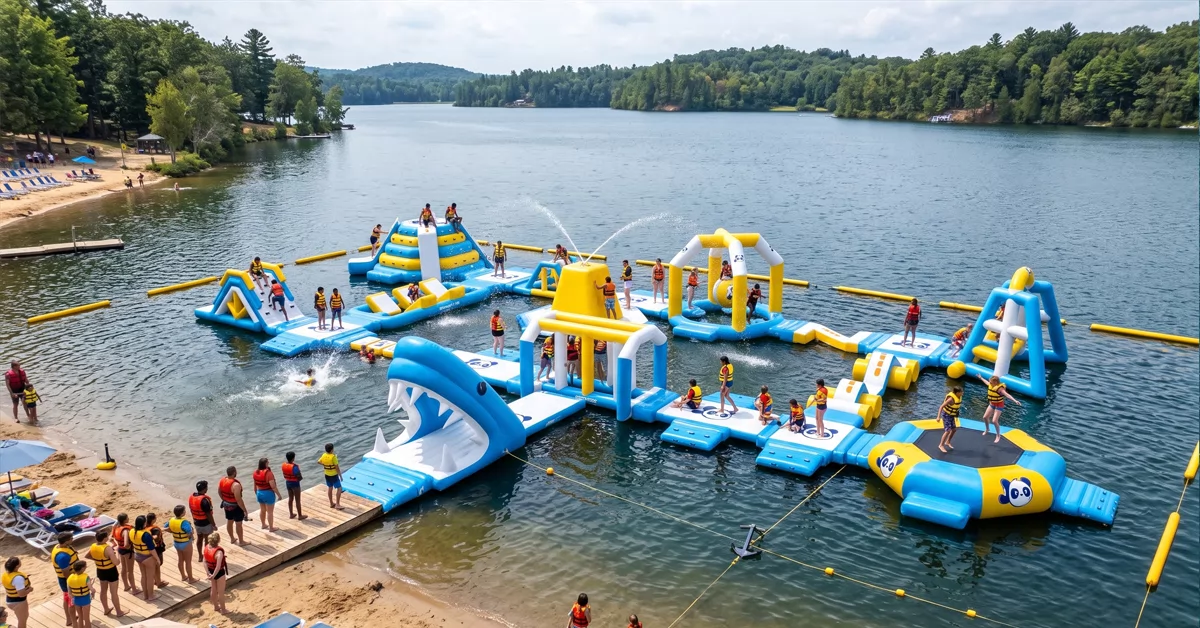
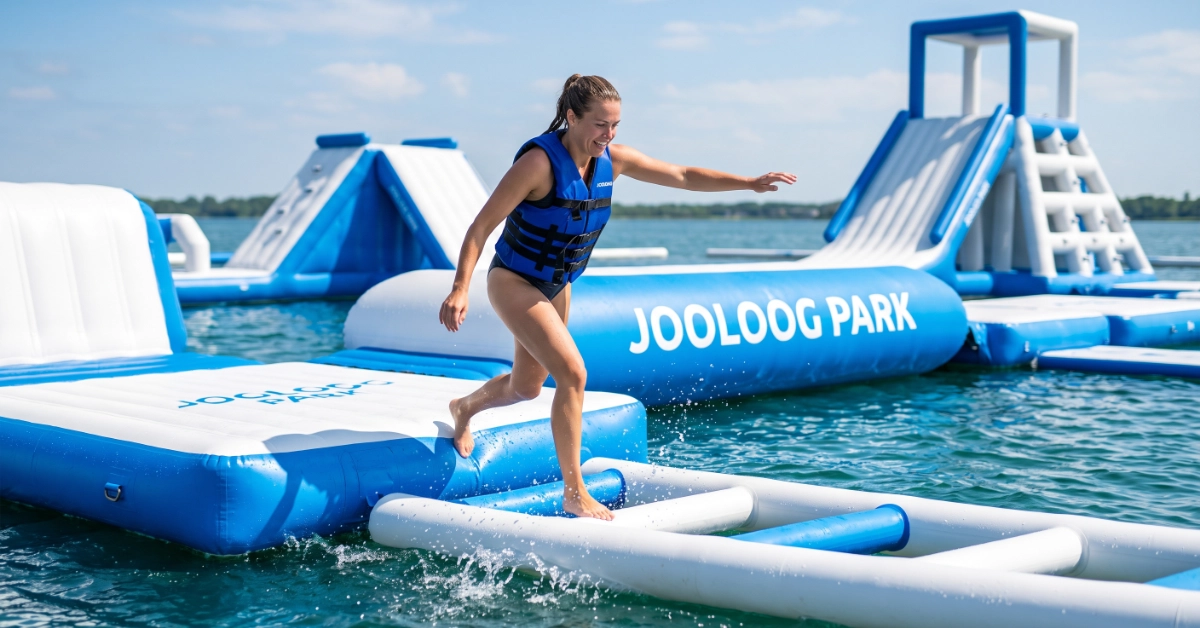
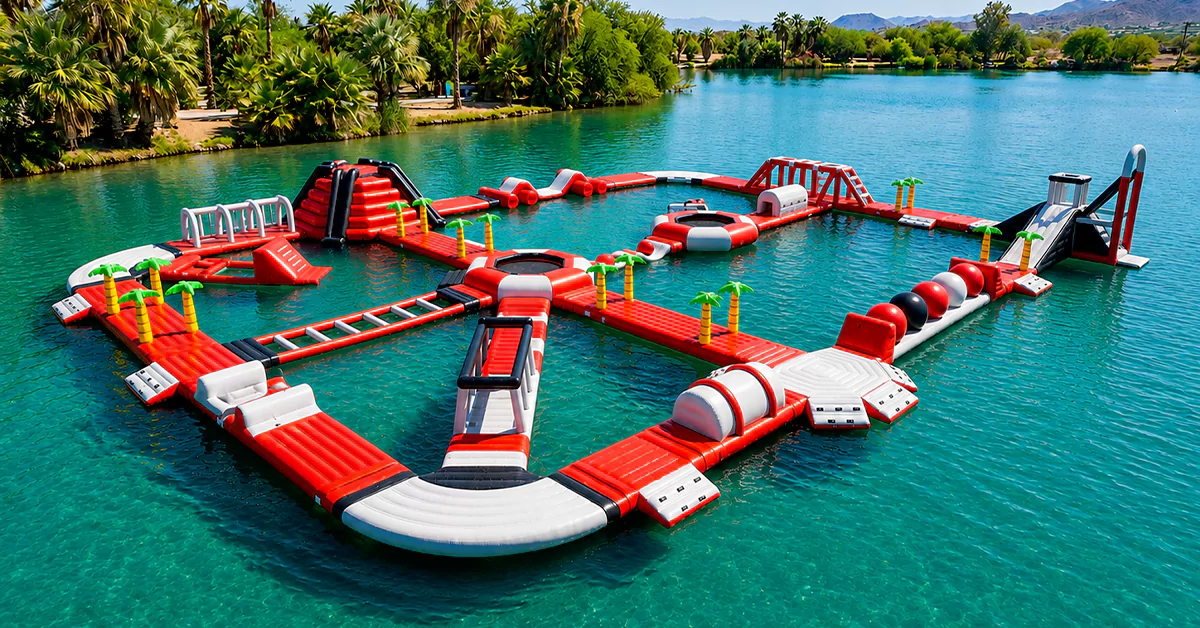
Most buyers start with the park. The ones who make money start with the water. A commercial inflatable water park is portable, but it is not site-agnostic — the depth, the substrate under it, the current, the shore access and the paperwork attached to the water body all decide whether your layout works or fights you every season. This guide is about that decision, before a single module is specified.

1. The four tests every site has to pass
Before pricing anything, check the site against four tests. Failing any one of them does not kill a project, but it changes the budget and the timeline:
- Water area. Enough open surface to hold the guest numbers you need, with a margin for mooring and a clear navigation channel.
- Depth and substrate. Enough depth for the anchors to hold at low water, over a bottom that can take them — sand, mud and gravel behave differently.
- Shore access. A place to land guests, an entry ramp, and somewhere to put changing, storage and a blower station.
- Tenure and permits. Who controls the water body, and what they allow to be placed in it. This is the test that most often moves a launch date, and it is the one buyers check last.
2. Water area and guest numbers
Area is the number that constrains everything else, and it is usually quoted badly. A workable planning figure for an inflatable water park with towers, slides and connecting paths is one guest per 8–10 m² of wet surface. Below that, queues form on the modules and the paths stop flowing — which guests read as "crowded" long before the park is at design capacity.
| Simultaneous guests | Wet surface required (8–10 m² per guest) | Typical venue |
|---|---|---|
| 60 | 480–600 m² | Hotel beach frontage, small lake |
| 120 | 960–1,200 m² | Campground lake, inland resort |
| 200 | 1,600–2,000 m² | Regional resort, municipal lake |
| 300+ | 2,400–3,000 m² | Large waterfront development, festival site |
If you are sizing against a specific shoreline, the modular floating aqua park modules are configured by area rather than by module count, which is the only way to compare quotes fairly.
Two practical notes. Design capacity and comfort capacity of an inflatable water park are not the same number — plan your ticket sales around the lower one. And if the water area you have only supports the smallest row, the answer is a smaller park, not a tighter layout.

3. Depth, anchoring and shore access
For an inflatable water park, anchoring is where a beautiful site becomes an expensive one. Modules are held by a multi-point D-ring matrix beneath each unit, connected to anchors on the bed. That system needs:
- Water depth that stays sufficient at low water — the constraint is your lowest level of the season, not the level on the day you survey.
- A substrate that holds — soft mud needs different anchors and longer scope than sand or gravel; rock may need a different approach entirely.
- Shelter from prevailing wind and current — an exposed shore means constant re-tensioning and, in the worst case, a park that has to come out during a blow.
Shore access is the half of the project that gets under-budgeted. Guests need a safe landing point; staff need a route to every module; and the blower station needs power and a dry position above the waterline. If guests have to walk through mud to reach the entry ramp, the park will photograph badly and review worse, no matter how good the modules are.
4. Venues that work — and what each one needs
The same modular system behaves differently across venue types, and each brings its own constraint:
- Beach resorts and coastal hotels. Strong existing guest base and a captive audience for premium sessions. The constraint is salt water and wave exposure — expect more rinsing, more anchoring attention and a shorter working season.
- Lakes and inland reservoirs. Usually the easiest operating environment: sheltered water, no tide, easy anchoring. The constraint is often regulatory rather than physical — many reservoirs restrict new permanent structures, which is precisely where a removable park has an advantage.
- Municipal partnerships and festival pop-ups. The highest utilisation per day of capital, because the park moves to the crowd. The constraint is logistics: transport, rapid installation and a crew that can build and strike in days.
- Rivers and tidal inlets. Workable only with a proper site assessment. Current, debris and level change all attack the anchoring plan, and the insurance conversation gets harder.
If you are weighing venues, the economics differ far more than the equipment does — the equipment economics of a commercial inflatable water park are covered separately, including what the capital costs per season rather than what it costs to buy.
5. Venues that fail, and why operators buy anyway
Four site types reliably disappoint an inflatable water park, and they are worth naming because they are the ones that look best in a photograph:
- Water too shallow at low season. Modules ground, anchors foul and the layout has to move — usually after the season has been sold.
- Strong current or open exposure. Re-tensioning becomes a daily job, and safety margins shrink exactly when the park is busiest.
- No legal tenure over the water. A verbal agreement with a landowner is not a permit. Operators discover this in the week before opening, with the park already delivered.
- No shore infrastructure. Nowhere to change, queue or store blowers turns a two-hour session into a logistics problem for guests.
The common thread is that all four are cheap to check and expensive to fix. A site visit and a conversation with whoever controls the water cost almost nothing before you order, and cannot be recovered afterwards.
6. Compliance, insurance and the paperwork that sets your opening date
Where the site passes the physical tests, the schedule usually slips on documentation. Two things decide whether you open on the date you have advertised:
- Product compliance. EN15649 and CE certification are what insurers and local authorities ask for. Ask for the certificates against the exact model and configuration you are buying, not a generic brochure page.
- Operating documentation. A written supervision plan, staffing ratios, an emergency procedure and a maintenance log. Insurers price the absence of these documents, and inspectors ask for them first.
Build the specification around what an inflatable water park has to survive: 0.9 mm commercial-grade PVC tarpaulin, heat-welded seams, drop-stitch decking rigid enough to walk on, and D-ring anchoring sized to your bed conditions. That is also what makes the all-in cost of an inflatable water park move — the difference between a quote for a resort and a quote for a pop-up event is mostly in these lines, not in the number of slides.
7. Conclusion: choose the water first
Commercial inflatable water park equipment is genuinely adaptable — it can be re-laid, re-themed, moved and stored. But adaptability is not the same as suitability. The operators who get a second and third season out of an inflatable water park are the ones who surveyed the water, checked the tenure and sized the layout to the surface they actually had, before they chose a single module.
If you have a site in mind, send us the water area, depth range, substrate and shore access and our team will tell you what layout the site supports — including when the honest answer is a smaller park than you planned.